Note: this list is specific to 2026, and the machines and prices in it are what is sold in the EU and the UK. It is the online retail shelf, not the dealer’s. Walk into a shop and ask for a heavy duty machine and you will be shown a Singer 44-series, a Janome HD or a Brother, and none of the badged platform machines below, because there is no margin in a €130 machine. Both shelves are real. This article is about the one you reach by typing heavy duty into a search box.
Nearly every guide to heavy duty machines leads with stitch counts and top speed. Neither has much to do with whether the machine gets through the hem of a lined, interlined blackout curtain, which is eight layers of cloth and a folded mitre at the corner.
If you have ever fed a lined blackout curtain toward the needle and watched the fold thicken as it came, you know what happens next before it happens. The machine buzzes. The handwheel stops. You get that faint hot smell off the motor while the needle sits half buried in the seam, and then either the thread snaps or the needle does.
There is one variable that decides whether that happens to you, and almost no buyer’s guide names it. It is not the wattage on the box.
Why I went looking
I killed a perfectly decent domestic machine on a set of interlined curtains. Not dramatically. It just started skipping stitches at the mitred corners, then skipping them everywhere, and by the third pair it was pushing the fabric rather than feeding it.
So I went shopping for something stronger, and found the category is a mess. Every European and UK brand now sells a “heavy duty” range. Singer, Brother, Janome, Necchi, Veritas, Jaguar, Minerva, Texi, W6, and a stack of retailer-badged machines besides. They all promise denim and canvas. They cost anywhere from £150 to £450. And their spec sheets are almost entirely composed of numbers that do not predict whether the machine will do the work.
I spent longer than I would like to admit reading manufacturer datasheets in German, Italian and Polish, cross-referencing service parts catalogues, and comparing product photography to work out which of these are actually different machines. This is what I found, starting with the part that matters most.
Two things came out of it. The first is a single mechanical property that decides whether a machine gets through eight layers of lined curtain and a mitred corner or stalls halfway up the hem, and almost no buyer’s guide names it.
The second I was not looking for. Several of the machines in this article are the same machine. Not similar, not comparable: the same tooling, the same hook, the same needle bar throw, out of the same Chinese factory, wearing different European badges. Two of them are identical on every specification either company publishes and sell ninety-five euros apart. I will show you which ones, and how you can tell without opening anything.
But the mechanics come first, because until you know which numbers matter you cannot see what the badges are hiding. That is the whole trick of this category. They are not lying to you. They are telling you the truth about the wrong things.
One rule before any of it: buy the most heavy duty machine your budget stretches to, and buy it on the mechanism rather than the feature list. Nobody in the history of sewing has run out of stitches. Everybody has run out of power.
Count what you actually used on your last five projects. Straight stitch. Zigzag. A buttonhole. Maybe a stretch stitch if you sew jersey. That is the honest total for most people, and it does not change after ten years. A machine advertising 200 patterns is selling you 196 things you will look at once in the shop and never select again.
Meanwhile the thing you will hit on the very first hem of a heavy lined curtain, the thing that decides whether the project finishes or gets folded into a cupboard, is whether the machine can drive a needle through a compressed stack at low speed. There is no accessory that fixes that. You cannot download more torque.
So the trade is simple and people get it backwards constantly. A 1,000-stitch machine that stalls on denim is a worse buy than an 18-stitch machine that does not, at any price. The stitch count is what the marketing department controls. The chassis, the motor and the foot lift are what the engineering department controls, and only one of those departments is trying to help you.
Spend the extra fifty pounds on mass and motor. Sewing machines have no upgrade path. You can add presser feet and change needles. Everything else is the machine you bought on the day, for as long as you own it.
The one thing that actually matters
Heavy sewing happens slowly. You approach a felled seam, you slow right down, you let the machine walk over the bump one stitch at a time, and for the worst of it you may turn the handwheel by hand. The needle has to develop enough force to pierce the stack at almost zero rpm.
That is exactly where a cheap machine is at its worst.
An AC motor is the kind in a blender or an angle grinder, and it is what you get in most machines under two hundred euros. It only pulls hard when it is spinning fast. Slow it down and the pull goes with it, so you get a lurch over the seam instead of a push through it, and if it stops in the stack it sits there getting hot. A DC motor keeps almost all of its pulling power down to a crawl. That is the whole difference, and it is the difference between finishing the hem and unpicking it.
So: a DC motor beats an AC motor, every time. And a DC motor with a speed limiter slider is the best thing you can buy at this money, because the slider is what lets you actually use the pull you paid for.
One more signal worth having. If a heavy duty machine advertises a lower top speed than an ordinary domestic, that is usually good news. It has been geared for pull rather than for the number on the box.
That is the whole of it. Right motor type, geared sensibly, with something that lets you crawl. Everything else on the box is decoration.
If you want the physics, the pedal circuitry and why the wattage figure is measuring the wrong thing, it is all in the technical section at the end. You do not need it to buy well. You need it to argue with a salesman.
What you do need is a way to see through the two claims every one of these machines makes on the front of the box. Both are close to meaningless, and both are easy to check.
The four numbers worth reading
A spec sheet for one of these runs to fifty lines. Four of them stand in for something you actually care about. The rest are decoration.
Wattage, as a proxy for how hard it can push a needle through a stack. It is a crude proxy. It measures the whole machine at the wall rather than output at the needle, and it tells you nothing about where in the speed range that power sits, which is the thing that decides whether you finish the hem. But the board and the lamp draw only a few watts between them, so a hundred watt machine really does have a bigger motor than a fifty watt one. Read it alongside the motor type, never instead of it.
Presser foot lift, as a proxy for how much bulk you can physically get under the foot. This is the one that decides whether the work fits at all. A standard domestic lifts about six millimetres. A lined, interlined curtain at a mitred corner is thicker than that, and no amount of torque helps you if the foot will not go over it.
Speed control, as a proxy for whether you can reach the torque you paid for. Heavy sewing happens at eighty stitches a minute, not eight hundred. A machine with the right motor and no way to crawl has sold you power you cannot get at.
Net weight, as a proxy for stability and how much metal is in it. And it is the one figure on the box nobody inflates, for a reason worth knowing: weight costs money to ship. Every manufacturer has an incentive to make a machine lighter and to publish a lower number, not a higher one. So when someone prints 8.5 kg, they are admitting to a cost they would rather not carry, which is why it is the most trustworthy number in the category.
Everything else on the sheet, the stitch counts and the pattern libraries and the top speed in large type, is either decoration or actively misleading. Two claims in particular are made by every machine here and mean almost nothing.
Every machine has a metal frame
This claim appears on essentially every heavy duty listing and has stopped carrying information.
It almost always means an internal die cast alloy skeleton, usually aluminium or zinc alloy, carrying the shafts and needle bar, with plastic shells over the top. That is how nearly all modern domestics are built, including cheap ones. The plastic you see is not structural.
The real variation is how much metal there is, and that shows up in weight. Weight is the only figure on the box nobody can inflate. Everything else is a claim; 8.5 kg is a fact.
Most of this category runs six to seven kilograms. One genuine outlier reaches eight and a half. A thirty percent mass difference on similar dimensions is real and you feel it as reduced vibration on thick work.
It is worth saying plainly that “heavy duty” has become a colour scheme. Black plinth, grey body, a font with corners on it. None of that is load bearing, and neither is the plinth.
Two cautions. Check whether a figure is net or gross, because a gross figure includes the extension table, pedal and accessory box and can flatter a machine by well over a kilogram. One retailer quotes the Texi Force at 7.8 kg; the importer’s own sheet gives 7.8 gross against 6.5 net. And be suspicious of a tall black plastic plinth around the base, which is a styling device that makes a light machine look substantial.
One shortcut when you cannot find a weight: read the warranty as an engineering statement rather than a legal one. Janome cover the HD3000 for twenty five years on materials and workmanship. Nobody underwrites a plastic frame for twenty five years.
That is the first claim disposed of. The second one is photographed on every box in the category, and it is worse.
Piercing layers, and the denim trick
Every heavy duty machine is photographed sewing folded denim. Almost none of them tell you the weight of the denim.
Brother promise ten layers of canvas. Singer show a stack that looks like a phone book. It means almost nothing.
Denim is sold by weight. Shirting denim is about five ounces per yard. Jeans are twelve to fourteen. Raw denim goes up to twenty one.
So eight layers of five ounce denim weighs about the same as three layers of proper jeans. And a felled seam on a pair of jeans stacks four to eight layers of that heavier cloth, pressed flat rather than loosely folded.
So the demonstration stack is often lighter than a single real seam on a pair of jeans, and much lighter than a curtain hem with lining, interlining and a mitred corner.
If you can test a machine in a shop, bring your own worst case. A folded corner of the actual fabric at the actual number of layers, sewn slowly. Thirty seconds of that tells you more than every spec on the box, and any dealer who will not let you try it is telling you something too.
So: the right motor, a way to go slowly, and enough lift to get the work under the foot. Three things. Here is who has them.
The machines
Now the criteria have somewhere to point. Read this table for the motor column and the lift column and almost nothing else; the rest is there so you can see what each maker chose to tell you and what they left out. The gaps are the interesting part.
| Machine | Motor | Net weight | Lift | Speed ctrl | Top speed | Street price |
|---|---|---|---|---|---|---|
| Janome HD3000 | AC | 8.5 kg | “extra high” | no | 860 | €550 and above, hard to find |
| Necchi Q132A | 90W AC | 7.2 kg | extra travel | no | 1000 | £200 |
| Veritas 21 Denim | 90W DC | 7.25 kg | no | 1000 | €329 | |
| Veritas 32 Titan | 90W DC | 7.25 kg | no | 1000 | €350–600, hard to find | |
| Singer HD6800C | DC | ~7 kg | yes | 1100 | €500–600 | |
| W6 N 2800 Pro | 70W DC | 6.23 kg | 2-step | yes | 860 | €200 |
| Veritas 17 / PRO | 90W AC | ~5.6 kg | no | 750 | €250–400, hard to find | |
| Brother HF27 / HF37 | 51W AC | 6.6 kg | not published | no | 800 | €262–350 |
| Fabric Mouse HD80 | 100W DC | yes | €292 |
Clone wars: the hundred watt cluster
Several of the machines in this article are the same machine. Not similar, not comparable. The same tooling, wearing different names, at prices that are not remotely the same. Start with the picture.
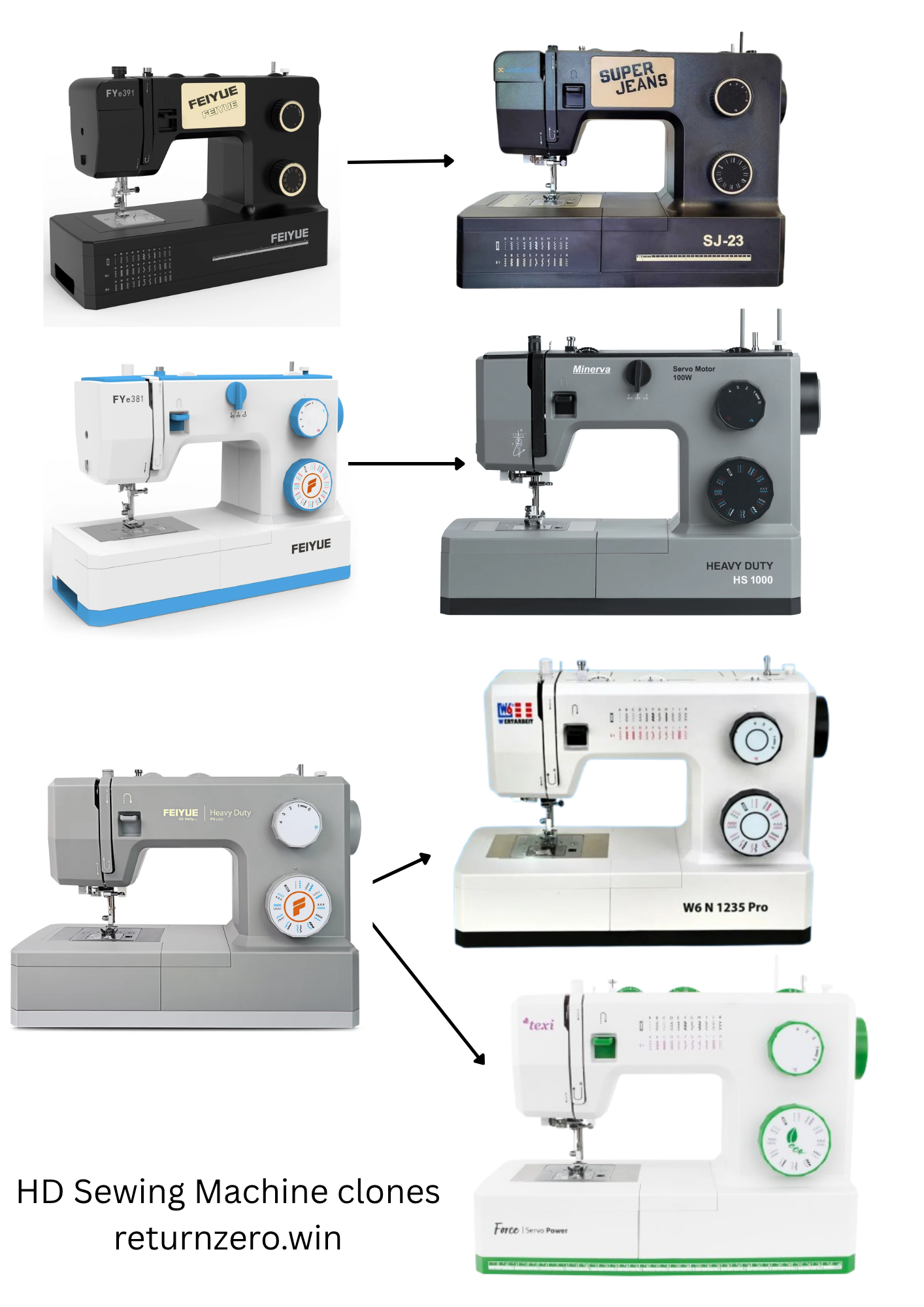
They come out of the same factory. Feiyue of Taizhou sell under seven of their own trademarks before you even count the European badges, and most people who own one have no idea.
They are among the largest sewing machine manufacturers in China, producing over 300 products across 31 series. Spec convergence and shell photography make it very likely the Fabric Mouse is a Feiyue, and reasonably likely the Minerva and Texi are too.
And Feiyue are not the only ones doing it. Zeng Hsing Industrial of Taiwan have been a designated OEM for Singer for decades, and have supplied household sewing machines to well known brands for over fifty years from plants in Taiwan, China and Vietnam. One company you have never heard of builds roughly thirty percent of every household sewing machine sold on earth. Nine to nine and a half million machines a year, and three in ten of them come out of Zeng Hsing. More than sixty percent of their own orders come from Singer alone. Those figures are Taiwanese trade press from 2013, so I would not lean on the decimal points today, but the shape of it holds, and it makes the point harder than Feiyue alone does. Two contract manufacturers you have never heard of build a very large share of the machines on the shelf. The badge on the front of a domestic sewing machine tells you less about who made it than almost any other appliance you own.
Badge engineering is normal and not a criticism. But it changes what you are choosing between. If three machines share a chassis, a hook and a motor, you are not choosing between machines. You are choosing a warranty and a phone number.
The parts are cheap and standard, which is good news. Look up a replacement bobbin case for any of these and you will find one part fitting Brother, Juki, Pfaff, sixteen Singer models, Feiyue, Minerva and Texi alike. Same for needle clamps and feed dogs. Consumables and common wear parts cost a few pounds and come from any sewing parts retailer, which beats proprietary components every time.
It also means shared parts prove nothing about who built what. The bobbin case in your heavy duty machine also fits a Pfaff.
In defence of clones
The heading on this section is a joke at the industry’s expense, not at the machines’. None of this is a criticism of the manufacturers involved, and the history of this trade argues hard the other way.
When Singer’s patents on the class 15 lapsed, and post-war Japan found itself with idle machine shops, skilled labour and an export market to win, the result was one of the great cloning episodes in manufacturing. Thousands of badge names came out of a few dozen Japanese factories, many of them names invented to sound American. Juki and Brother were among the firms building them. And a great many of those machines were not merely equivalent to the Singer they copied: they were better engineered, smoother running, and held to tolerances the original did not. Parts interchanged with the real thing. They took enough of the market to reshape the industry that had been copied.
Those are the machines collectors now hunt. A well-kept Japanese class 15 from the 1950s will outlast and often outsew most of what is sold new today, and prices reflect it.
So a shared platform is not a warning, and I would rather see more of it than less. Competition on common tooling is exactly what drove that generation of machines to get good, and a category where four brands buy the same well-made chassis and then compete on warranty, support and price is a healthier place to shop than one where every maker guards a mediocre design of its own. Feiyue and Zeng Hsing are building competent machines at a price no vertically integrated European brand could reach.
What a buyer is owed is not exclusivity. It is enough information to tell whether the premium in front of them is paying for engineering or for paint. Buy the clone, cheerfully. Just do not pay sixty percent extra for the badge glued to it.
So much for the claim. Now the evidence. Here is every hundred watt machine in the article, with the figures each maker publishes and the holes where they do not. Read the geometry column and the price column together.
None of these is really competing with the machines further up. They are competing with each other, and on the evidence below, several of them are not doing even that.
| Machine | Motor | Stitches | Max length × width | Lift | Top speed | Net weight | Hook | Street price |
|---|---|---|---|---|---|---|---|---|
| Texi Force | 100W DC servo | 23 | 4.0 × 6.0 mm | 2-step, unpublished | 800 | 6.4–6.5 kg | horizontal rotary | €162 |
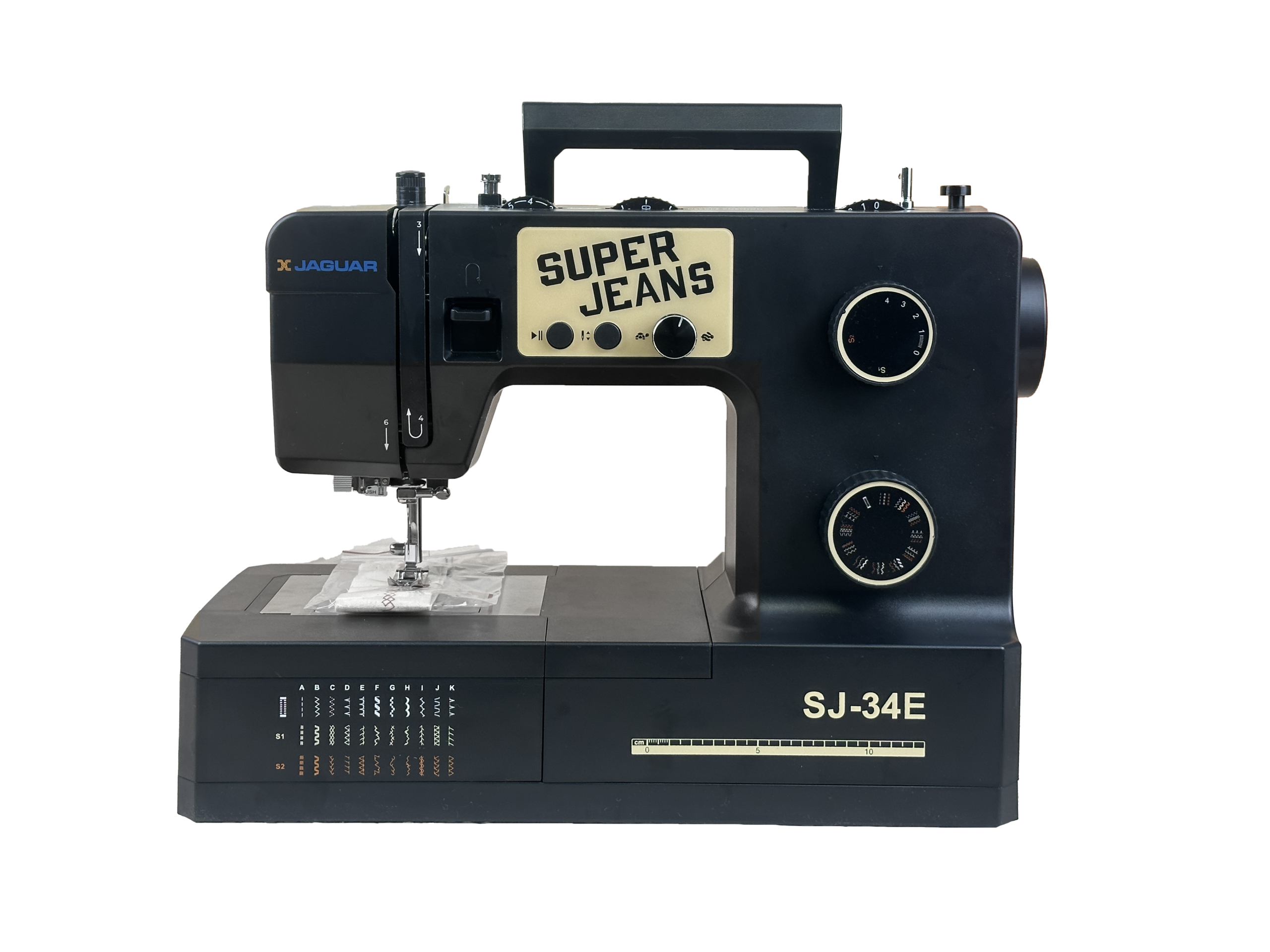
| Jaguar SJ-23 | 100W DC servo | 23 | not published | 5.5 mm | 800 | 6.4 kg | horizontal rotary | €257 |
| W6 N 1235 Pro | 100W DC brushless | 24 | 4.0 × 6.0 mm | 2-step, unpublished | 860 | 6.44 kg | horizontal rotary | €120–140 |
| Minerva HS1000 | 100W DC servo | 34 | not published | 5.5 mm | 850 | ~6.9 kg gross | horizontal rotary | €239–259 |
| Texi Bro | 100W DC servo | 24 | 3.6 × 4.0 mm | 5 mm | 750 | vertical oscillating (CB) | €115 | |
| Texi Gold | 100W DC servo | 24 | 3.6 × 4.0 mm | 5 mm | 750 | vertical oscillating (CB) | €112 | |
| Jaguar JS-50E | 100W DC | not published | 3.6 × 4.0 mm | not published | 750 | 6.2 kg | vertical, front-loading | discontinued |
The top two rows are clones in the literal sense. Every figure they both publish agrees, and so does everything the table has no column for: both one-step buttonhole, both LED, both automatic needle threader. Now read the last column. The Texi Force is €162. The Jaguar SJ-23 is €257. Ninety-five euros more, sixty percent more, for the same machine with a different name on the front. The only thing separating these two machines on paper is which figures each chose to print: Texi give you the geometry and no lift, Jaguar give you the lift and no geometry. Lay the two rows on top of each other and you have one complete spec sheet for one machine.
Then read the two Texis underneath. The Bro is €115 and the Gold is €112, three euros apart, because a company selling the same platform under two of its own names has no reason to pretend otherwise. Clones within a brand get priced like clones. Clones across brands get priced at whatever each brand thinks it can ask. That is the commercial logic of this entire category sitting in four rows, and it is invisible until the specifications and the prices are in the same table.
And the cheapest machine in the group is the W6 at €120 to €140, on the same geometry and the same hook as the €257 Jaguar, with a brushless motor and a ten year warranty behind it. Whatever the others are charging for, it is not a better machine.
The stitch geometry column is the one to read. Maximum stitch length and zigzag width are set by needle bar throw and feed dog travel, which are tooling. You cannot change them with a different dial or a firmware table, and a manufacturer has no marketing reason to round them oddly. So when two machines from different brands agree on both, that is a much stronger signal than a shared wattage.
Read the column that way and this is not one family, it is two. The top four share a geometry and a hook. The bottom three share a different geometry and an entirely different bobbin architecture, and that second group crosses brands: two Texis and a Jaguar, same needle bar throw, same feed dog travel, same top speed. Texi are selling across both. Whatever badge is on the front, the machine underneath is one of at least two separate platforms, and the name tells you nothing about which.
Both families trace back to Feiyue, and inside the horizontal rotary group you can go further than that and name the donors. The Feiyue FYe350 is a hundred watt servo machine with twenty-three built-in stitches, a top drop-in bobbin and an integrated metal frame. That is the Texi Force down to the stitch count, and the W6 sits one stitch away from it. The FYe381 is the same platform carrying thirty-four stitches, published at 4.0 by 6.0 mm on a horizontal rotary hook at 6.4 kg, and thirty-four is the Minerva’s number. One platform, three European badges, three models off the same tooling.
The vertical group is a tighter fit. It matches the Feiyue FYe300, listed with twenty-four built-in stitches, a four-step buttonhole, a hundred watt brushless AC servo motor, an industrial vertical swing shuttle and a maximum of 750 stitches a minute. Set that against the Texi Bro and Texi Gold, which are twenty-four stitches, four-step buttonhole, hundred watt AC servo, vertical CB hook, 750 stitches a minute. Five specifications, including the hook architecture and the top speed to the digit.
Neither identification comes from a teardown, and Feiyue publish nothing useful on their own product pages, so both rest on retailer specification sheets and shell comparison. But this is a good deal firmer than the usual guesswork, and it tells you something a spec sheet will not: the machine you are considering is one of two Chinese platforms with a European name attached, and the choice in front of you is which importer you would rather deal with.
Stitch count, by contrast, is a poor fingerprint. The Minerva runs thirty-four on the same motor rating and much the same weight as machines running twenty-three, because the stitch cam stack is one of the cheapest things in the machine to vary. Motor rating, hook architecture and stitch geometry are harder to fake, and those are what actually cluster.
A note on the word servo, because the labels are not consistent. Texi describe theirs as an AC servo, W6 as a brushless servo, Minerva and Jaguar simply as a servo. Those cannot all be different things, and a genuine AC servo in a two hundred euro domestic machine is not plausible. What is actually in all of them is a brushless DC motor with electronic commutation, which is why the table above lists them as DC regardless of what the box says. That is the right architecture for low speed torque, and it is the distinction that matters. It is just not what the industrial world means by servo.
Machine by machine
That is the shape of the category. Here is what each machine actually is, and what each maker decided not to mention.
Singer HD6800C. The marketing is vague, promising a motor “sixty percent stronger” than standard with no baseline stated. The hardware is better than the copy: Singer sell a genuine replacement part, DC Motor #68015337, fitting the HD6800C along with the CHD6700, HD6600, HD6605, HD6705 and HD6805C. A service part number is harder evidence than any product page, because nobody writes marketing copy for a replacement motor. So this has a real DC motor, a speed slider, needle down, adjustable pressure, metal frame and stainless bed plate at around 7 kg. The criticism that remains is the gearing: eleven hundred stitches per minute is pointed the wrong way for heavy work.
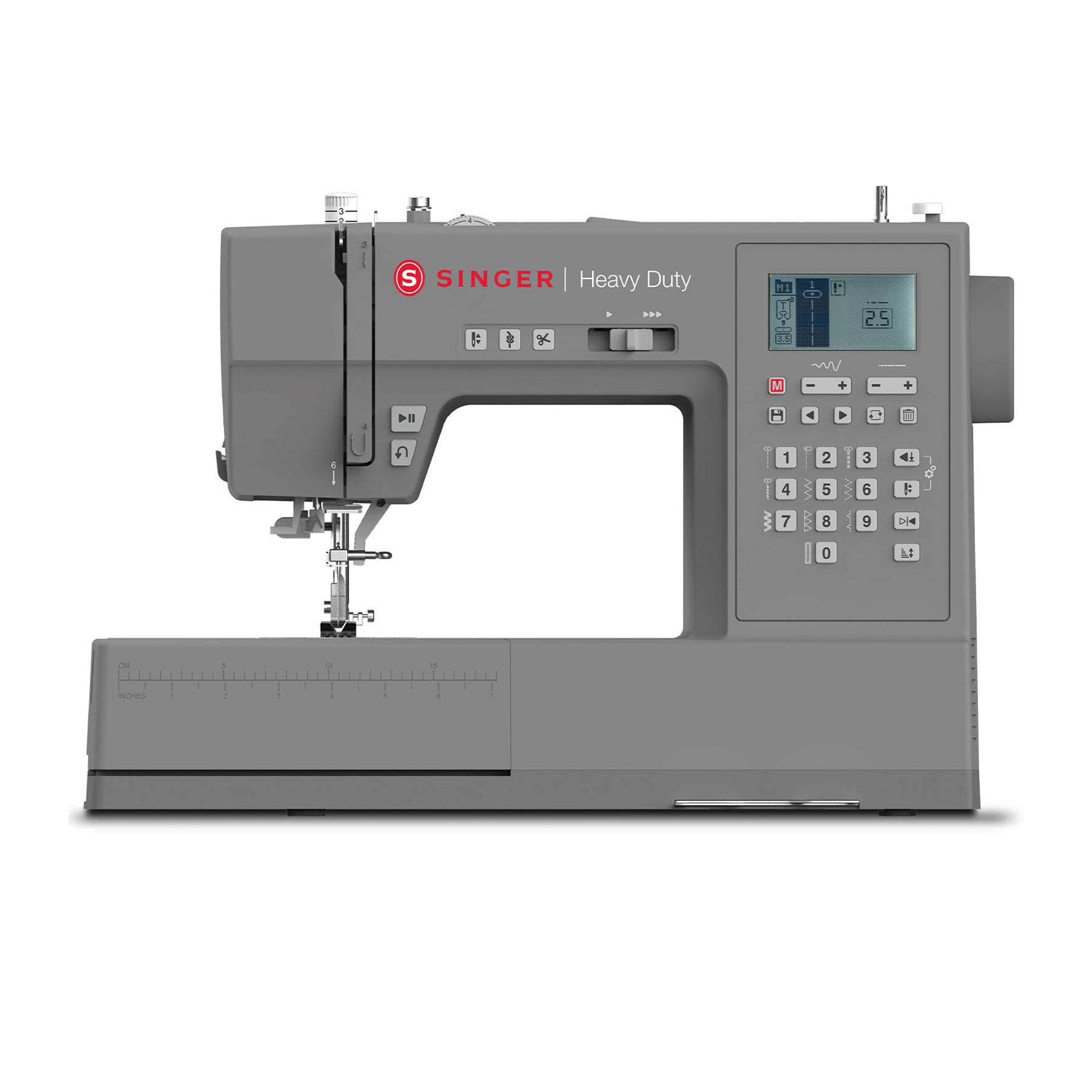
A warning about the rest of Singer’s heavy duty range. Singer sell the best motor architecture in this category and the worst one under the same badge, with the same denim photography and the same “more power” language on both. The mechanical models, the 4411, 4423, 4432 and 4452, are the ones to avoid. They pair a conventional AC motor with an advertised 1,100 stitches per minute. A thousand stitches a minute and an AC motor is the wrong answer twice: a motor whose torque collapses at low rpm, geared for speed rather than pulling power. The DC motor is what makes the 6800C worth considering, and the 44-series does not have it.
Hold on to that, because the machine everyone will tell you to buy instead makes the opposite mistake: all the metal you could want, and the wrong thing driving it.
Janome HD3000. The only machine here with genuinely different mass. At 8.5 kg on a die cast aluminium body it carries roughly thirty percent more weight than anything else, backed by a warranty of 25 years on workmanship, 5 on electrical and 1 on labour. Eighteen stitches on a dial. It runs a conventional AC motor with no speed control, so it gives up the low speed torque advantage entirely. Janome publish no wattage figure for it on any official page I can find, which is its own kind of answer. The heaviest machine here has the least useful motor architecture in it, and it is still the one most people recommend.
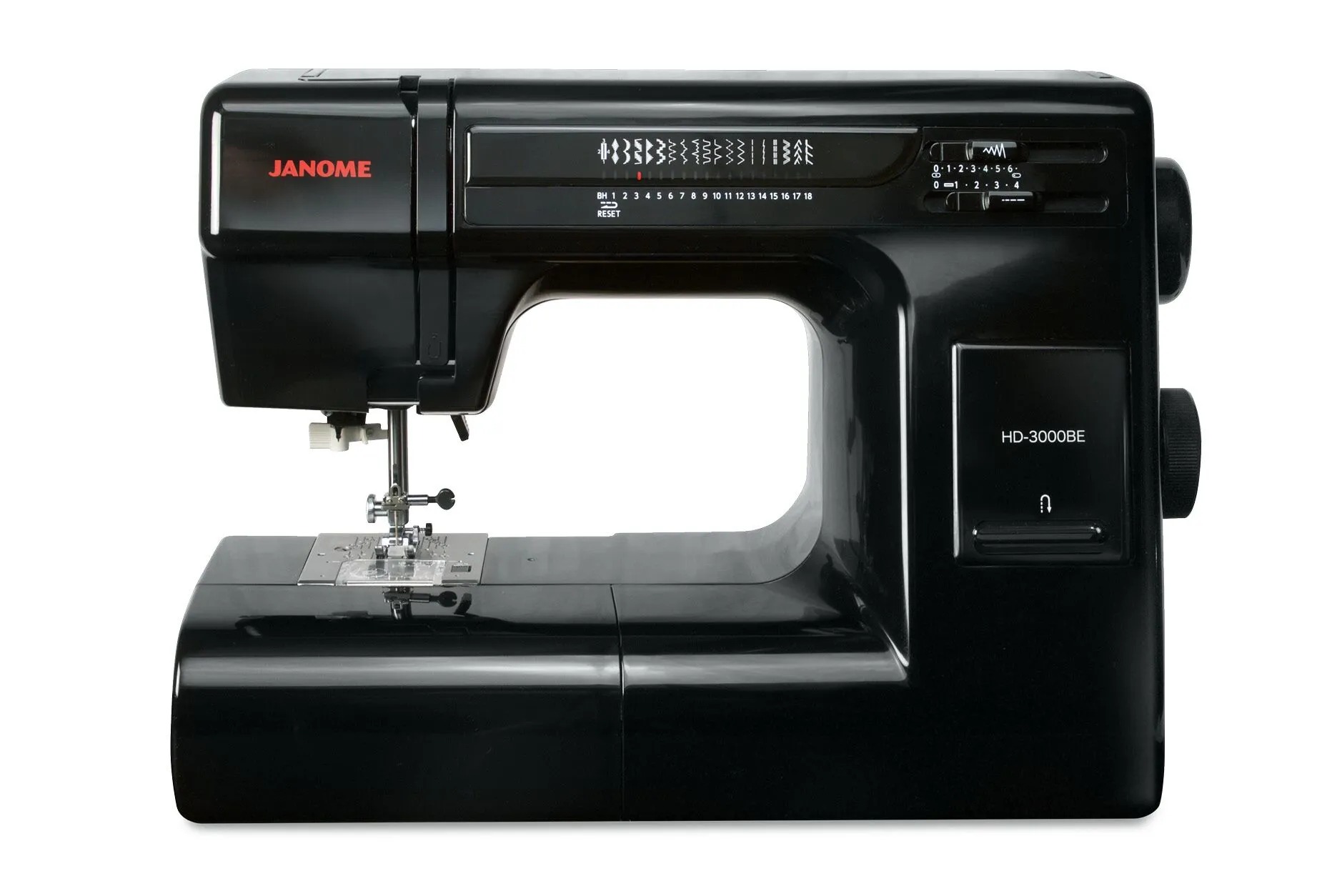
So why does the reputation survive? Because torque at the needle is not only a motor property. Gear ratios and flywheel mass contribute as well, and eight and a half kilograms of machine carries real momentum through a thick intersection. That effect is genuine, and it is most of why this machine earned what people say about it. But momentum is compensation, not architecture. A universal motor still surrenders its pulling power exactly where the work happens, and no amount of flywheel makes it controllable at eighty stitches a minute. In 2026, at what this machine now costs, an AC motor is not something I would recommend. It was the right machine for a long time. It is not the right machine at today’s price against today’s alternatives. Getting hold of one here is its own problem. Most of the HD range, the 1000 through the 5000, is chronically low on stock in the EU and UK, and what stock exists swings by a hundred euros or more in either direction depending on the week and the seller. Any figure quoted for a Janome, including the one in the table above, is a weaker number than the same figure would be for anything else on this list.
Keep the shape of that in mind: the best body on the list, ruined by what is driving it. The next machine repeats the mistake almost exactly, and has rather less excuse.
Necchi Q132A. 7.2 kg net, metal frame, metal bed plate, adjustable presser pressure, rotary hook, extra travel foot lifter. Second heaviest here on the chassis side, and easy to overlook because Necchi publish their specifications in Italian and not clearly in English.
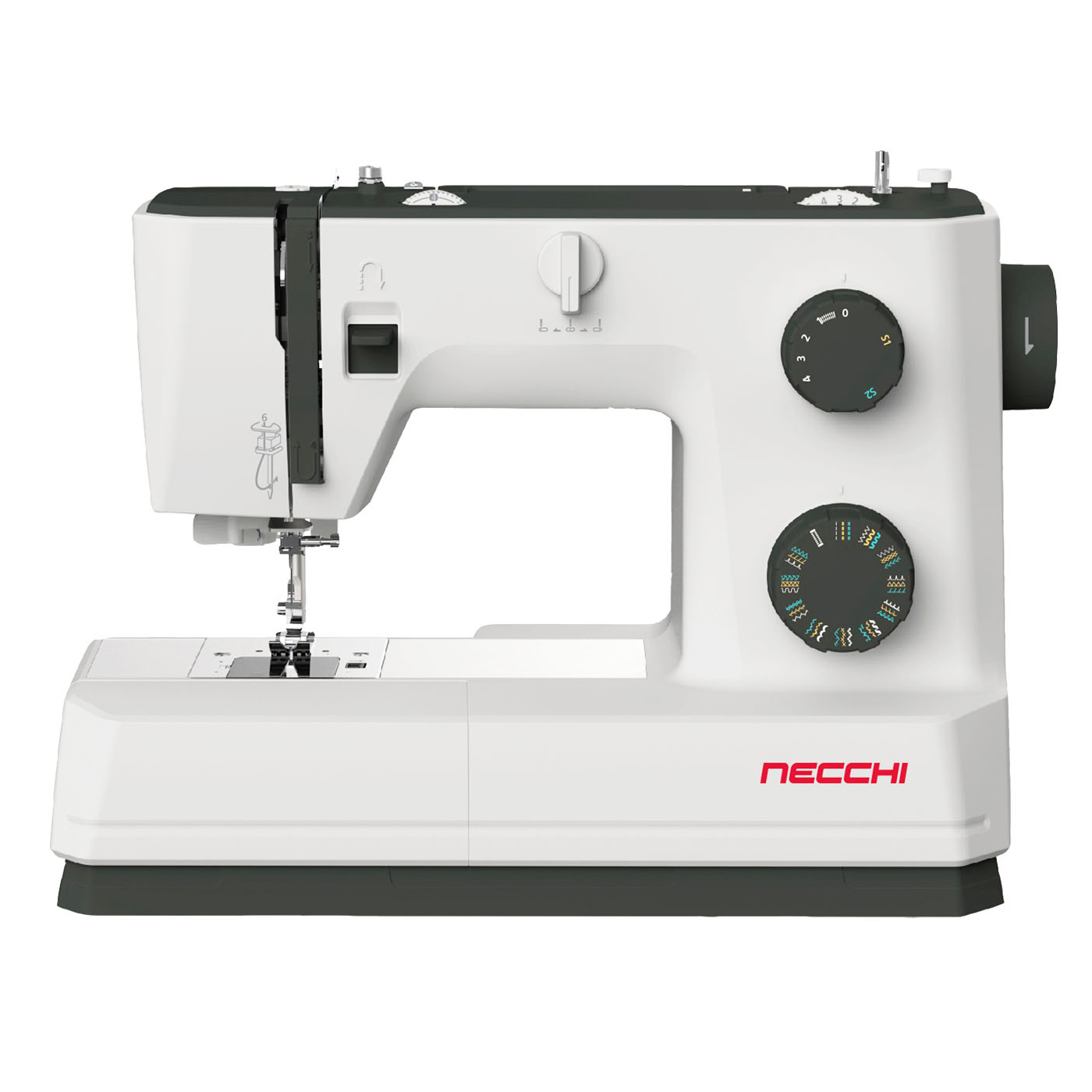
The motor is the problem. Ninety watts, AC, driving a machine geared to 1,000 stitches a minute with no speed limiter. That is the Singer 44-series configuration described a moment ago, sitting under a considerably better chassis. Necchi publish the wattage and not the type, which is its own kind of answer. Their Italian retailer Bittarelli lists the pedal as a rheostat, and by the argument in the technical section a rheostat only drives a universal motor. Italian retail calls most pedals a reostato, so that supports the inference rather than settling it, but it points the same way as the top speed and the missing limiter.
So the Necchi is the mirror image of the Feiyue-platform machines. Excellent chassis, wrong motor. They have the right motors on ordinary chassis. Nobody in this price bracket gives you both, and that is the central frustration of the whole category. Necchi do have DC motor machines and I have noticed a pattern, they all end with a “D” suffix but none of them are marketed as heavy duty.
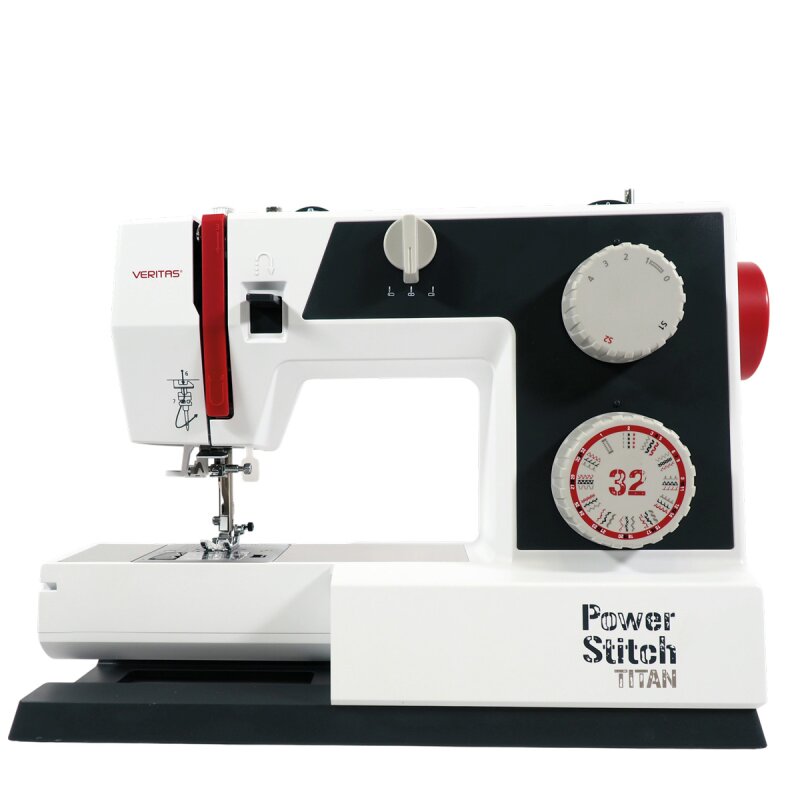
Veritas Power Stitch 21 Denim and 32 Titan. The best drive architecture on this list, and the only manufacturer selling the gearing rather than the wattage. Ninety watts DC through two drive belts with an intermediate reduction stage, which is the correct answer to the low speed torque problem twice over: the right motor type, then geared down to multiply what it produces. Almost nobody else does both, and nobody else says it aloud. Aluminium frame, proper dimensioned datasheets, 7.25 kg on the 21 Denim. The 32 Titan adds adjustable presser foot pressure, which the 21 Denim does not list. Neither has a speed slider. That is a choice, not a consequence of being mechanical: the slider lives on the motor control board, not in the stitch mechanism, and the W6 N 2800 Pro and the Feiyue FYe355 run stitch dials and a slider side by side. Veritas fitted the board and left the slider off.
Then check the model number twice, because the same brand sells the trap directly alongside it.
Veritas Power Stitch 17 and PRO. The older models, and the reason to read the model number carefully rather than the brand. These run an AC motor, not the DC unit in the 21 Denim and 32 Titan, so the two-belt reduction is compensating for the weaker architecture rather than multiplying a good one. They are also the lightest machines in this comparison at around 5.6 kg. The two-belt arrangement is inherited rather than invented: Veritas date the Power Stitch line to 2023 as successors to the Toyota Power Fabric, and the brand’s European operation, Crown Technics Austria, was founded in 2019 to continue the AISIN and TOYOTA sewing machine brands. That is worth knowing, because it explains why the older AC machine has better gearing than the newer DC ones. The belts came from somewhere else.
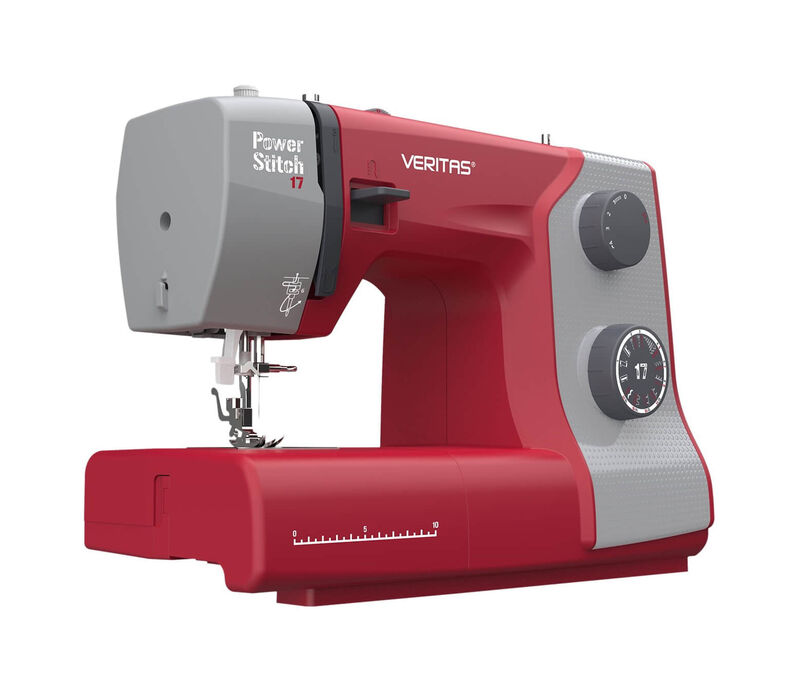
Veritas confirm the 17 and the PRO are identical in technical data and differ only in colour and supplied accessories, so do not pay more for the PRO expecting a stronger machine. Within the Veritas range the jump from a 17 to a 21 Denim is the one that buys you something real.
Six machines in, and every one has failed on a specification it declined to print. The next one prints it.
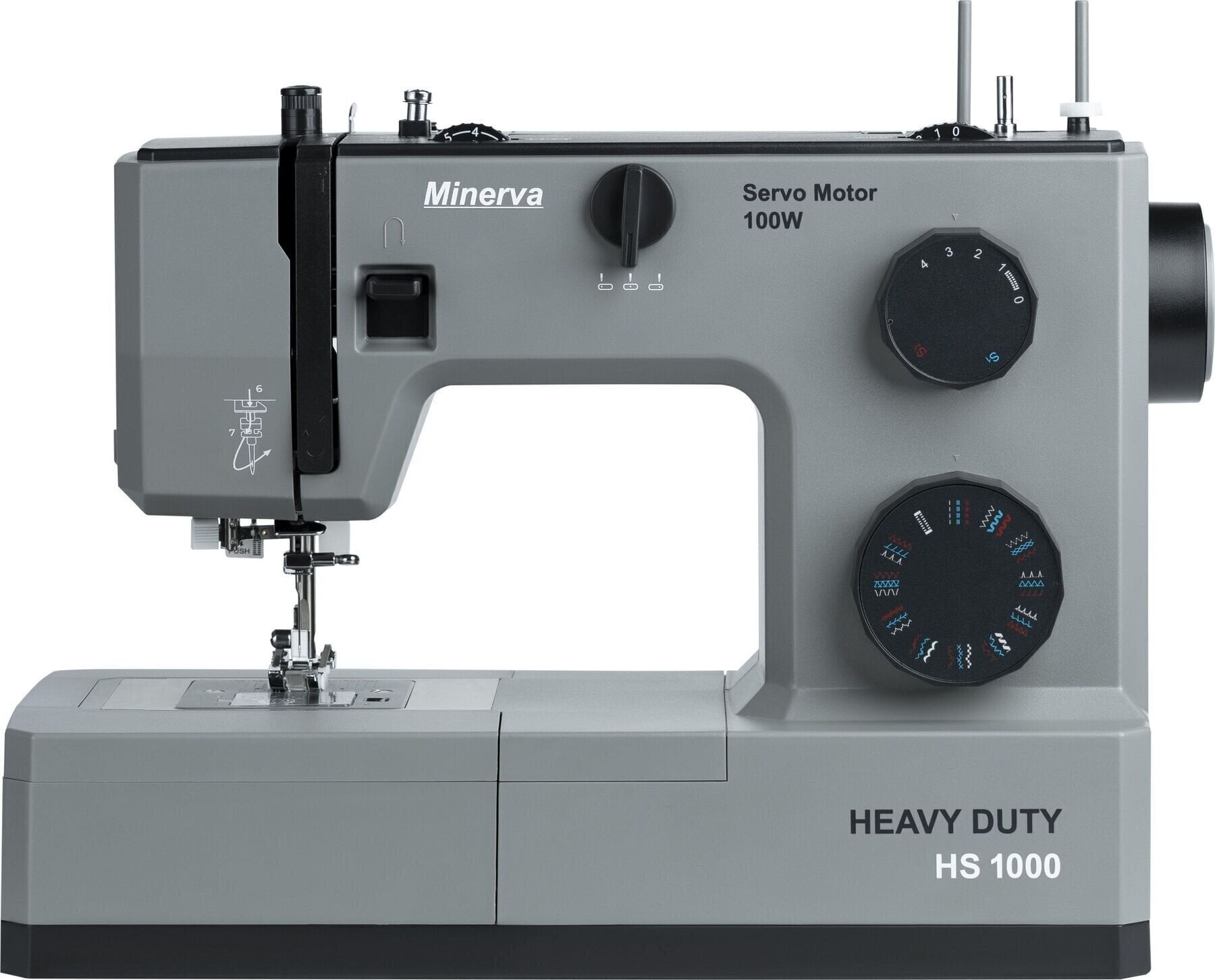
Minerva HS1000. 100W, horizontal rotary, adjustable pressure, seven point feed. Its seller quotes a ten millimetre foot lift, and I originally printed that as the one real figure in the category. It does not hold. Feiyue’s own parameter sheet for this casting, the FYe381, gives the presser foot lift as 5.5 mm, and the ten has no manufacturer behind it. See the follow-up. The catch is weight: 6.9 kg is quoted alongside dimensions that cannot be the machine, so it is probably a gross figure including the extension table. No speed slider.
W6 N 1235 Pro. The best motor on this list and the most transparent seller in the category by a distance. Brushless DC, so it has the low speed torque of the other DC machines with none of the brush wear, which is presumably why W6 are comfortable underwriting it for ten years with a twenty year parts commitment. W6 publish a fifty line comparison table with net weight to the gram, working space to a decimal and free arm length in millimetres, plus a ten year warranty and a twenty year parts commitment. That transparency reveals a 6.44 kg machine with the same seven segment feed dog as the rest of the FYe3 series, which is honest rather than impressive. Good motor, ordinary chassis, excellent support.
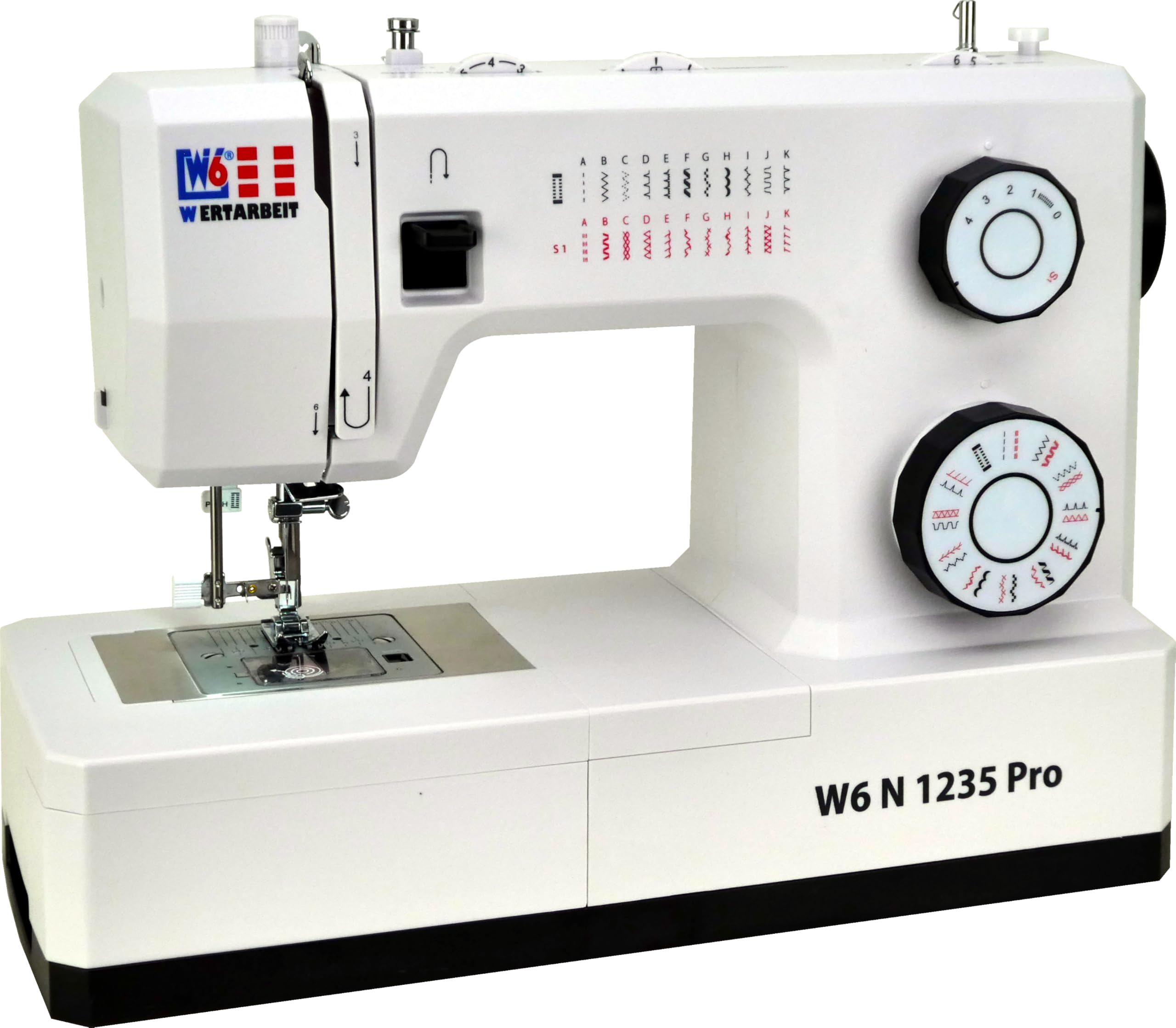
The one thing W6 do not publish is the foot lift, which they describe only as two-step. That is the same mechanism the Minerva has, and neither seller will say what the second step reaches. Feiyue publish 5.5 mm for the standard position across this whole platform and stop there. I have since bought a machine on the same casting and measured it: the second step is 8 mm. Given the shared stitch geometry, hook type and platform, the W6’s is probably the same, but that is my ruler and not their specification, so I am not printing it in the table. If you own one, a ruler under a raised presser foot settles in ten seconds what the entire industry has declined to tell you, and I would still like to know the answer.
W6 N 2800 Pro. Not sold as heavy duty at all, and the most instructive machine on this list for exactly that reason. Seventy watts DC, 6.23 kg, seven segment feed dog, adjustable presser pressure and a speed slider, on a computerised model priced below the 1235 Pro.
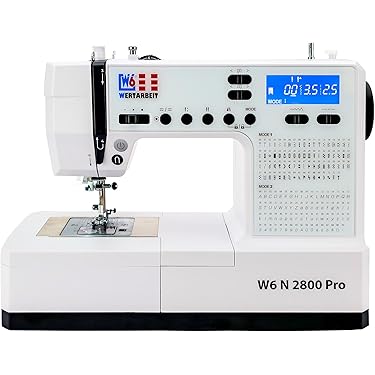
Put the two side by side: identical bodies, identical 860 stitches per minute, 215 grams apart, both DC. The machine that is not called heavy duty has more feed dog segments and a speed limiter the heavy duty one lacks. What the badge actually buys you is thirty watts.
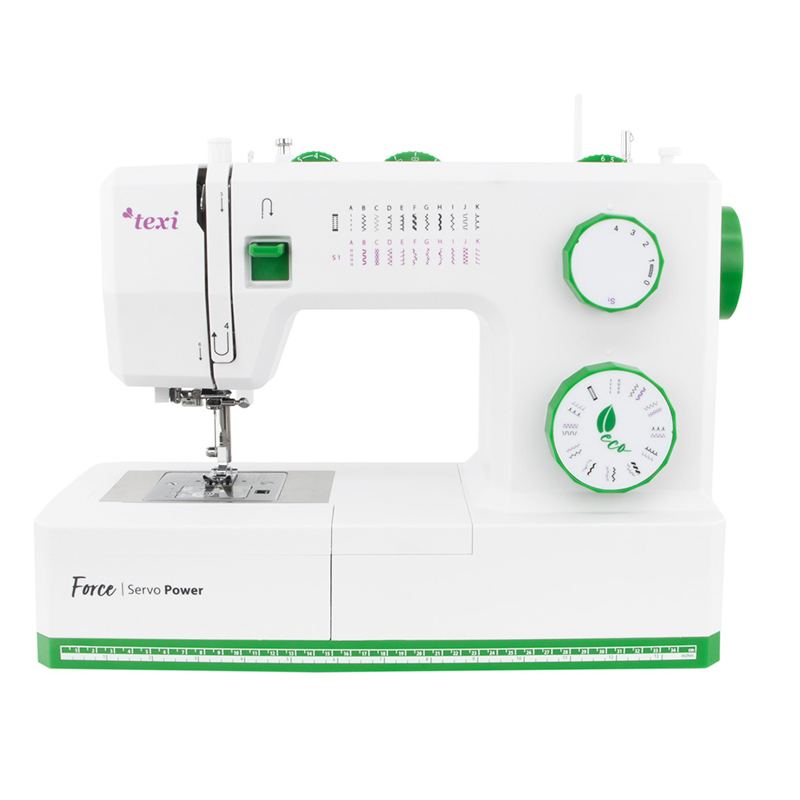
Texi Force. 100W, metal frame, seven segment feed, two step lift, and 100 to 240 volt input, which confirms a switching supply and a DC bus whatever the motor is called. Texi is Strima, primarily an industrial distributor, and their published specs are among the most honest here. Net weight is 6.4 to 6.5 kg depending on which listing you read, once the shipping figure is stripped out. No speed slider, so pedal only. Five year warranty.
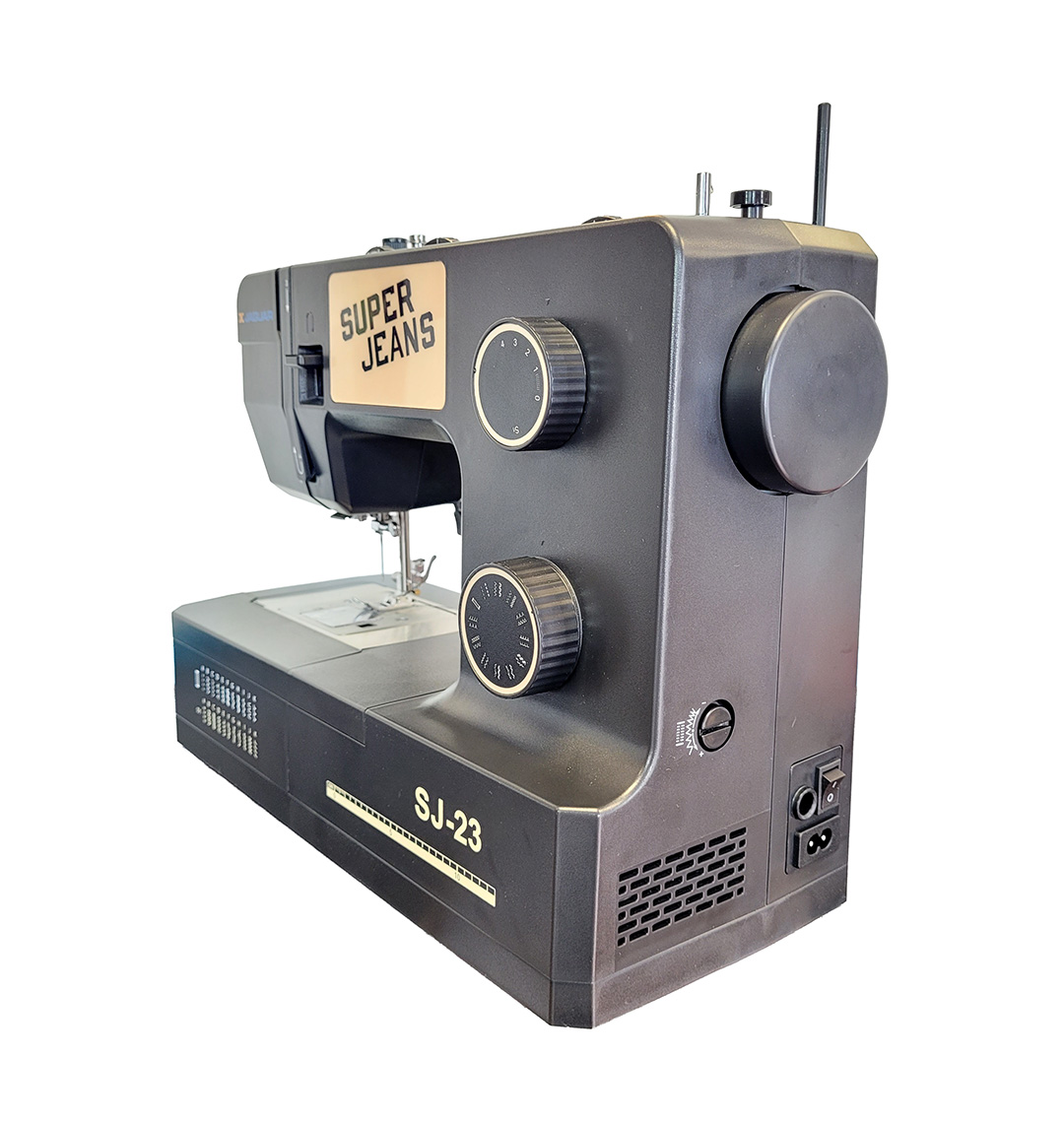
Jaguar JS-50E and SJ-23. The JS-50E is 6.2 kg net at 750 rpm with a maximum stitch length of 3.6 mm and width of 4.0 mm, which is a compact platform rather than a heavy duty one, though it does have real speed control and needle positioning. The SJ-23 publishes a 5.5 mm foot lift, which is an ordinary domestic lift on a machine sold as Super Jeans.
Brother HF27 and HF37. The weakest entry here, and the motor settles it: 51 watts, AC universal. That is half of what the Feiyue-platform machines draw, and the lowest published figure in the category. The heavy duty range with the strongest branding has the smallest motor in the category, and it is the architecture that gives up its torque exactly where heavy sewing happens.
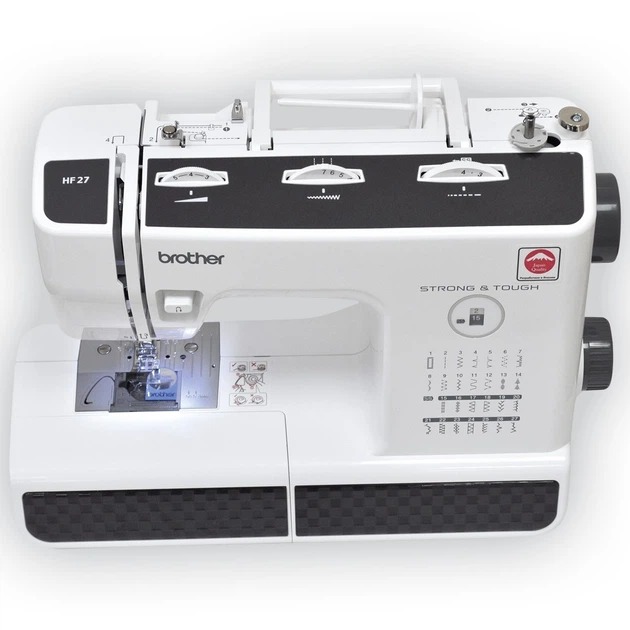
You do not have to take Brother’s word for the motor type, because they supply a rheostat pedal, and a rheostat only works with a universal motor.
Everything else is respectable. 6.6 kg net puts it mid-pack on mass, above the Texi Force and the W6. The 800 stitches per minute is sensibly geared rather than chasing a speed figure. Metal chassis, metal needle plate, 5 point feed dog, three year parts and labour guarantee. The J foot with a levelling button is genuinely useful, a small toggle that stops the foot tipping as it climbs onto a seam, though it is a presser foot and you can buy one for any low shank machine for a few pounds.
But there is no speed limiter, no adjustable presser foot pressure anywhere in the specifications, and the foot lift is unpublished. Brother also quote 8.5 kg in some places, which is the gross figure including the hard case, so check which one you are reading.
These are competent general sewing machines. As heavy duty machines they are the thinnest claim on the list, and the specification that matters most is the one they are worst at.
Which leaves the machine that does the opposite: everything Brother left off, bolted to a chassis with less claim to it.
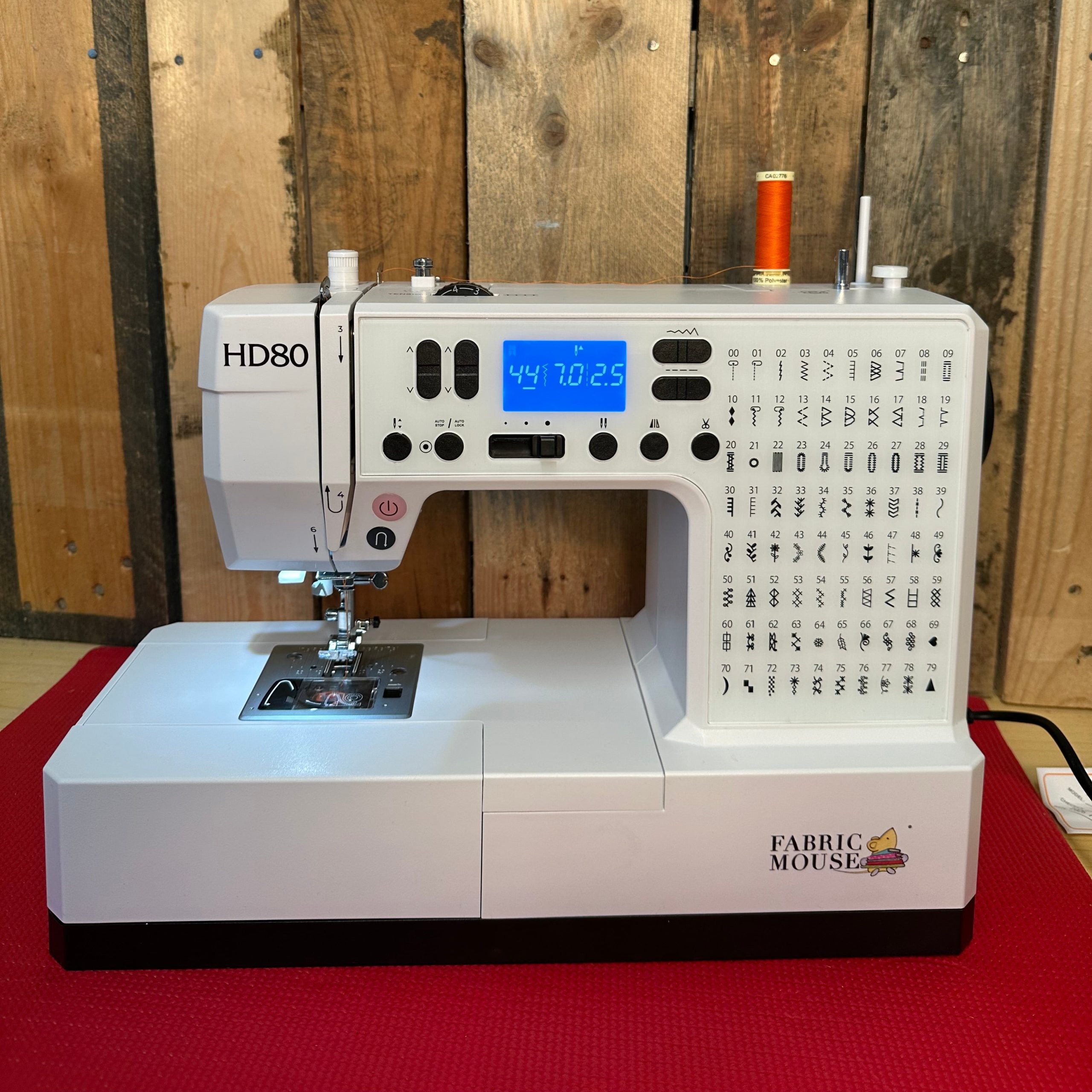
Fabric Mouse HD80. The best convenience package here: automatic thread trimmer, needle up/down, auto lock, speed slider, eighty patterns. The trimmer and needle positioning both require shaft position feedback, so the control system is real. The caution is the chassis. The shell is identical to the Feiyue FY415 down to the button layout, model designation placement and base moulding, and Feiyue rate that platform at seventy watts with an aluminium and plastic body against Fabric Mouse advertising a hundred watts and full metal. The motor is a 100 watt DC unit, so the retailer has clearly specified something better than Feiyue’s base rating, but the tooling underneath is still the lighter computerised platform. Feiyue’s box feed system belongs to their FY710, not this range. Worth noting that Fabric Mouse’s cheaper machine sits on the heavier chassis, so you can pay them more for less metal.
That is the category, top to bottom. Which leaves one more question, and it is the one everybody eventually asks: should you be shopping in this category at all?
The semi-industrial trap
At some point in your research you will run into the tier above: the Juki TL series, the Reliable Barracuda, the Janome HD9, the Bernette B08, the Brother PQ1600S. Straight stitch only, aluminium bodies, 1,500 stitches a minute, knee lifts, automatic thread trimmers. They are recommended constantly, usually by influencers, and they cost between €1,000 and €2,500.
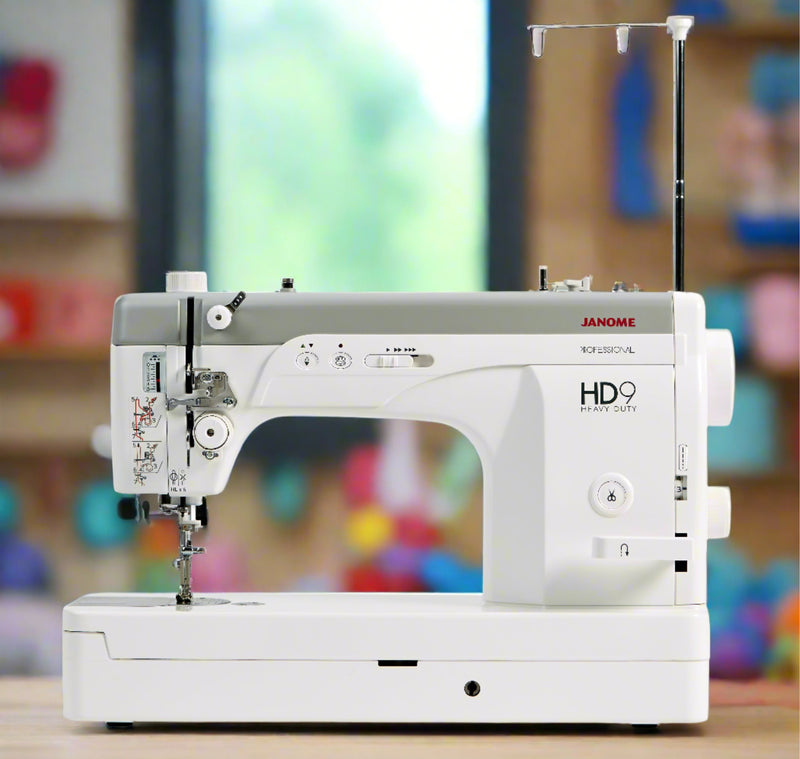
They are good machines. They are also, for most people, the worst value in the entire sewing market, and it takes about thirty seconds with a price list to see why.
A Jack H2 is a full industrial walking foot machine. Not semi-industrial, not industrial-inspired: a proper single needle lockstitch head with compound top and bottom feed, a direct drive servo motor, needle positioning, self oiling, a 13 mm presser foot lift, 8 mm stitch length, a double capacity bobbin and 2,500 stitches per minute. It comes on its own table with a stand and a cotton stand, delivered assembled. In the UK and Ireland it sells for around £600 to £800 complete, and there are cheaper variants without a walking foot.
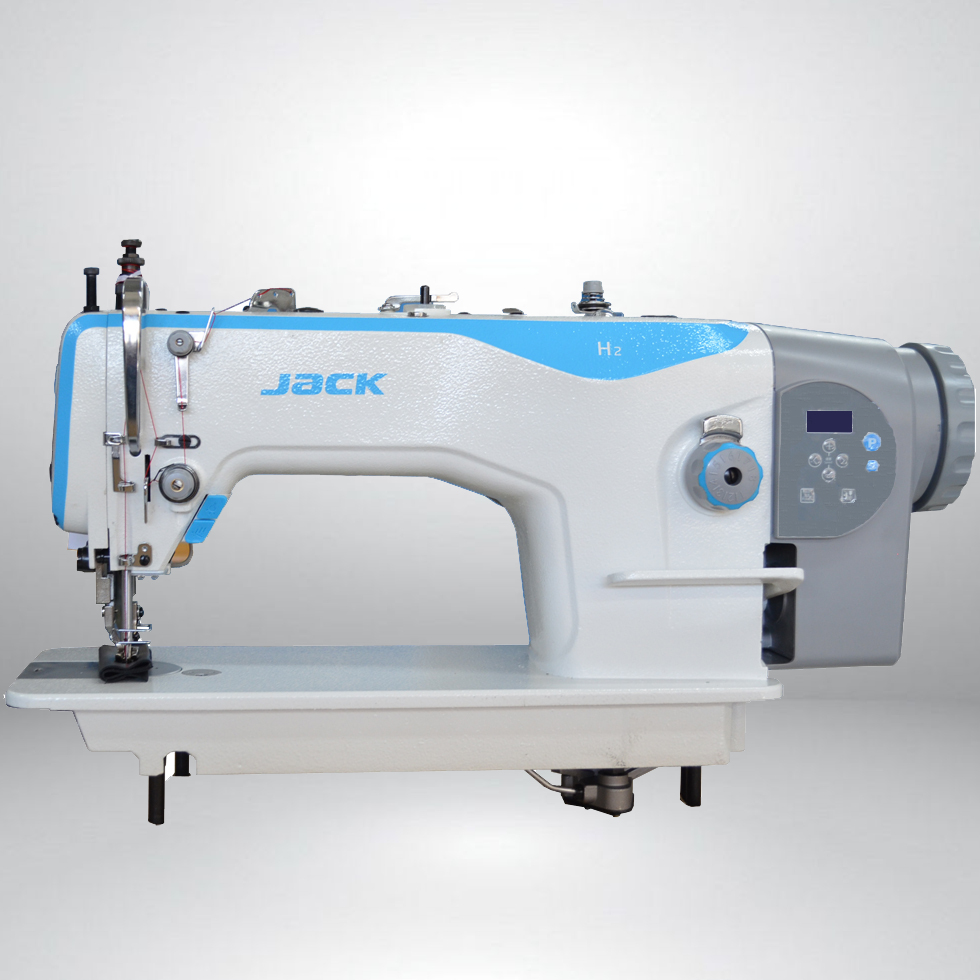
So the honest comparison is this. For less money than a Juki TL, you can have a machine with a walking foot, which none of the semi-industrials have. That single difference matters more than everything else on their spec sheets combined, because the reason your layers shift, your lining creeps and your vinyl sticks is that the top layer is not being fed. A straight stitch semi-industrial at 1,500 spm with a static foot solves a problem you did not have while leaving the one you did.
You are also getting a bigger bobbin, a taller foot lift, a longer stitch, a knee lift and an oil system, on a machine built for eight hour production days rather than enthusiastic weekends.
There is one good reason to buy the semi-industrial instead, and it is worth stating accurately rather than dramatically: permanence. A Jack H2 table is about 120 by 50 cm, which is a small desk and smaller than most people picture when they hear “industrial”. The problem is not floor area. It is that the machine is bolted into that table and stays there. You do not fold it away, you do not lift it onto the kitchen table for an afternoon, and you do not carry it to a class.
So the question is not whether you have room. It is whether you can give a corner up permanently.
That is the only case, and it is narrower than it sounds. A semi-industrial weighs 12 to 17 kg, which is not portable in any useful sense. You will not lift it in and out of a cupboard weekly and you will not carry it to a class more than once. It lives on a table too.
Moving house is not a reason. The table comes apart with four bolts and the head lifts out. That is an afternoon, once, not a thousand euros.
The genuine case is one situation: you sew on the dining table and clear it for dinner, and you will never have a dedicated corner.
Even then, ask what the extra thousand to two thousand actually buys. Straight stitch only, at speed, on a bigger flatbed. Portability is a reason to rule out the industrial. It is not on its own a reason to spend fifteen hundred euros.
Everyone else is paying roughly double for the option of moving a machine they are not going to move.
But if you have a corner of a garage, a spare room, or any wall you can give up, the value case is not close. Buy the industrial and put the difference toward thread and feet.
So what should you actually buy?
Start with the uncomfortable part. Nothing in this category satisfies all three of the things this article has argued for. Not one machine here pairs a DC motor with a speed limiter and a foot lift published in millimetres. You are not choosing the best machine. You are choosing which of the three to give up.
Best value: W6 N 2800 Pro, around €200. DC motor, speed limiter slider, adjustable presser foot pressure. It is lighter than the 1235 Pro and rated lower in watts, which cuts against the rule this article opened with. But once both machines have the right architecture, what is left to buy is control, and this is the one that has it.
Best mechanism: Veritas Power Stitch 21 Denim, €329. The only maker here selling the gearing rather than the wattage, and the only one answering the low speed torque problem twice over: the right motor type, then geared down through two belts to multiply what it makes. 7.25 kg on an aluminium frame. No speed slider, and that absence is what you are paying for the mechanism with.
Cheapest without compromising the motor: W6 N 1235 Pro, €120 to €140. Brushless DC, a ten year warranty, a twenty year parts commitment, and the most transparent published specification in the category. No speed slider. At this price that is an easy trade, and it is half what the same platform costs with a different badge on it.
If the foot lift matters most: nothing here, on the published evidence. This slot used to say Minerva HS1000, on the strength of a ten millimetre lift. That figure was the seller’s, not the manufacturer’s, and Feiyue’s own sheet for the same casting says 5.5 mm. Nobody in this comparison publishes what their second step reaches. The one number I can offer is measured rather than published: 8 mm, on a machine from the same platform, described in the follow-up.
Think twice about the Fabric Mouse HD80 at €292. It has the DC motor and the slider, and easily the best convenience package here: thread trimmer, needle up and down, auto lock. But it sits on the lighter computerised chassis with no published weight and no published lift, and the ninety euros over the N 2800 Pro buys a thread trimmer and eighty stitch patterns. That is the exact trade this article opened by arguing against.
Then sit with this. The N 2800 Pro and the Fabric Mouse HD80 are the same machine. Both are Feiyue FY4 series, both on the FY415 shell Feiyue themselves rate at seventy watts. One was respecced to a hundred watts, given a heavy duty name and a thread trimmer, and priced ninety euros higher. The other is sold as an ordinary domestic. The best value machine in a category built entirely on the words heavy duty is the one nobody bothered to put them on.
And if you can give up a corner of a room permanently, none of the above is the best use of the money. A Jack H2 is a full industrial walking foot machine, delivered assembled on its own table, and it sells in the UK and Ireland for roughly £600 to £800, about €700 to €950. That is less than the semi-industrials it outclasses and more machine than anything else on this page. Jack’s plain lockstitch models cost less again if you drop the walking foot, and they are still a lot of machine for the money, but the walking foot is most of the reason the H2 beats the tier above it, so it is a poor place to economise. Plain industrial lockstitch heads start lower again, around €400 to €450 new, and that sets a ceiling over this entire article. Above roughly that price a domestic machine is no longer buying you more machine. It is buying you zigzag, buttonholes and the fact that it can be lifted, and it is worth being honest with yourself about whether that is what you are spending the difference on. The catch, either way, is that an industrial stays where you put it. The semi-industrial section above sets out why that trade is better than it sounds.
That is the answer. Everything underneath it is the working: the motor architectures, the pedal circuit, the foot lift, the thread limits and the checklist to take to a dealer. It is in the technical section below, kept out of the way so that the argument did not have to stop every four paragraphs to explain itself.
Update, 1 September 2026. I bought a Feiyue FYe355, the platform itself rather than any of the badges on it. How I came to choose the FYe355 is the long version.
Corrected at the same time. Researching that purchase turned up Feiyue’s own parameter sheets, which contradict a figure this article relied on. The Minerva HS1000’s ten millimetre foot lift is a retailer’s number; the manufacturer’s sheet for the same casting says 5.5 mm. I had singled that ten out as the one honest figure in the category and built a recommendation on it, and both are now withdrawn above. The lift figures in this article are otherwise unchanged and still mostly unpublished. the follow-up sets out how that came apart.
Corrected 19 September 2026. The title of the r/SewingForBeginners thread asked for corrections and got them. The Janome HD3000 entry claimed that fewer stitches meant tighter needle to hook tolerances; that was reasoning dressed as fact and it is gone. “Thirty percent more metal” is now thirty percent more weight, which is what was actually measured. The shuttle section said a vertical hook handled heavier thread; the removable bobbin case is what does the work, and the section now says so (crkvintage and Large-Heronbill, from opposite directions). The Veritas entry no longer treats the missing speed slider as a consequence of the machine being mechanical. The thread section gained the maximum needle size route to a thread ceiling (Large-Heronbill). The speed control section now admits what it never covered, controller reliability on the DC machines. The scope note says which shelf this list is (TheOriginalMorcifer). A check of every source link at the same time found the Necchi’s bed plate is metal rather than stainless, and moved the Veritas 17’s weight and belt drive onto sources that still exist.
The technical section
Everything below is the working. It is here rather than up there because you should not have to read a physics lesson to buy a sewing machine, and because the argument above stands on its own. But every claim in it rests on something, and this is the something. Read it if you want to check me, or if you are the kind of person who wants to know why.
Speed control, and the pedal problem
A DC motor is only as good as the thing controlling it, and this is where budget machines separate hardest.
The complaint you hear repeatedly from owners of cheap machines is that the pedal is effectively an on/off switch. There is a dead band at the top of the travel where nothing happens, then it leaps to most of its top speed, and the usable range in between is a few millimetres of foot movement. Owners describe going from zero to a thousand stitches a minute with no controllable middle at all.
The pedal is the cheapest component in the box and the only one you touch continuously. Manufacturers know this and price accordingly.
It is also the one component that will tell you the truth about the motor when the spec sheet will not. A rheostat pedal drops voltage by burning the surplus off as heat, and that only works with a universal AC motor. A DC or brushless motor cannot run from one at all, because it needs an electronic controller shaping the current. AC motors are loud and there is that annoying hum when you press the pedal softly, So if a listing or manual mentions a rheostat, or if the pedal gets noticeably warm after twenty minutes of slow sewing or if you hear that hum, the machine has a universal motor no matter what the marketing calls it.
It is also a mapping problem rather than a motor problem. The pedal is usually just a variable resistor or a hall sensor reporting position to the control board. What you feel is the curve the board applies to that signal, and a cheaply tuned board maps it aggressively so the machine feels lively in a showroom. That tuning is exactly wrong for heavy work, where you want the bottom fifth of the range spread across most of the travel.
One feature fixes most of it, and it is worth more than twenty watts of motor.
A speed limiter slider caps maximum speed regardless of how far the pedal goes down. Set it low and your foot’s full travel maps onto a narrow, slow range, which restores fine control. This is the most useful control on a heavy duty domestic and it costs the manufacturer almost nothing. Most mechanical machines do without one, but that is a habit rather than a law. The slider is a control board feature and has nothing to do with how stitches are selected, and the W6 N 2800 Pro and the Feiyue FYe355 run stitch dials and a slider on the same casting. So its absence on a mechanical machine is a decision the maker took, and it is worth weighing against the usual argument that fewer electronics means fewer failures.
There is a cost on the other side that the first version of this article did not mention, and should have. On an AC machine the pedal is the controller and there is nothing else to fail. On the DC platform machines the pedal only reports position, and a control board decides how much current the motor gets. That board is what lets the motor pull at a crawl. It is also the part that has to cope when the needle stops in the stack and the motor asks for everything at once: either the board limits the stall current, or something has to absorb it. Not one manufacturer in this comparison publishes anything about the controller, its current limit or its thermal protection, and the DC machines get their low speed advantage entirely on the board’s say-so. The one published counterweight is W6’s ten year warranty on the same platform, which is either confidence in the board or a bet against it. I have not opened one yet. When I do, the follow-up will carry what I find. Until then, treat the controller as the unmeasured risk on the DC side, in the same way that an unpublished lift is the unmeasured risk everywhere else.
So that is two things worth checking that nobody advertises. There are four more, and one of them is a number most of these manufacturers will not print at all.
The parameters worth checking
Motor type. There are three architectures in this category and they are not equal.
An AC universal motor is brushed and series-wound, the design in a blender or angle grinder. Cheap, compact, and paired with the pedal it ships with, its torque collapses as speed drops toward zero. The motor itself can pull hard at a standstill given full voltage. The pedal is what refuses to give it any.
A brushed DC motor holds close to full torque down to a crawl, which is the whole point. Carbon brushes rub against a commutator to switch the current, and those brushes are a consumable that eventually wears out.
A brushless DC motor, also written BLDC, has the same torque curve as brushed DC but switches the current electronically instead. Nothing rubs, so it runs cooler and quieter and lasts far longer. Brushless is a type of DC, not an alternative to it, and it is the best of the three.
Most cheap machines use a universal AC motor with rheostat or those typical cheap two potentiometer pedals, the motor is same as brushed series-wound design that lives in a blender or an angle grinder. It is compact and cheap and makes plenty of power, but only when spinning fast due the pedal it usually comes with. As you slow down, voltage goes down and with it the torque. Pressing the pedal harder does raise the torque, so this is not quite a dead end, but it cannot raise it on its own: the same lever commands speed, and the two arrive together. So you get a lurch over the seam rather than a push through it. Worse, the fault feeds itself. The needle stops in the stack, and with the motor stationary the rising current burns more of the supply in the pedal, so less arrives at the windings than when it was moving. It cannot reach the speed at which the arrangement works, because it is stuck; and it is stuck because it cannot reach that speed. Pressing harder does not open the loop. The motor sits there drawing current and turning it into heat, which is the smell you get off it.
A permanent magnet DC motor behaves differently because these usually have better controllers. Torque here is roughly proportional to current rather than to speed, so it holds near full pulling force down to a crawl, and the controller can feed it more current as the load rises. This is why a machine with a decent DC motor punches through a thick intersection at two stitches per second and a universal motor machine cannot.
“Servo” is not a fourth category. It is a word four of these manufacturers use to mean four different things, and I will come back to it later with their own descriptions side by side, because they cannot all be right.
Wattage is measuring the wall, not the shaft. The number on the box is total appliance draw for the whole machine, motor plus board plus lamp. In practice the board and the LED account for only a few watts, so it is a fair rough proxy for motor size, and a hundred watt machine really does have a bigger motor than a fifty watt one. What it is not is output at the needle, and it says nothing at all about where in the speed range that power sits, which is the thing you actually care about. A hundred watts is also about a fifth of what a real industrial servo produces.
For a sense of what the phrase costs to apply: W6 sell a seventy watt machine and a hundred watt machine that weigh 215 grams apart, run identical speeds and sit in identical bodies. Only one of them is called heavy duty.
Presser foot lift. The most useful published number in the category, and most manufacturers refuse to publish it. A standard domestic lifts about six millimetres. Machines built for bulk lift nine or more: the Juki TL-2010Q is nine by lever, the Janome HD9 is 12.7.
Be careful how you read the phrasing, because I had this wrong myself. Almost every machine in this comparison has a two-step lift, where the lever travels past its normal stop into an extra-high position for bulk. Two-step names the mechanism. It does not tell you what the second step reaches. So the useful distinction is not two-step against millimetres. It is published against unpublished, and it turns out that almost nothing here is published. Where a figure does exist it is usually the standard position rather than the second step: Feiyue give 5.5 mm for this whole platform, Jaguar a quarter of an inch for the same casting. A seller who gives you a figure is at least telling you something, provided you check which of the two positions it names. A seller who only names the mechanism is telling you nothing, and “extra high” on its own is worth exactly as much as it sounds.
The specification a manufacturer refuses to publish is a specification.
Presser foot pressure adjustment. A dial or screw changing how hard the foot presses down. Without it you are stuck with one setting for silk and canvas. Now standard even on cheap computerised models, so treat its absence as disqualifying rather than its presence as impressive.
Feed system. All of these are bottom feed. Feed dog tooth counts get quoted a lot and tell you almost nothing, because the count tracks stitch width rather than grip: a wider zigzag needs more segments to support the needle across the swing. Most of the Feiyue platform machines run seven. Ignore the number.
What matters more is whether you can fit a walking foot. None of these has one built in, but almost all take standard low shank snap on feet. A twenty pound walking foot will do more for a lined curtain hem than thirty watts of motor.
That is not a retreat from the argument above, because torque and feed solve different problems and fail differently. Torque is what drives the needle through the stack; feed is what gets the layers to the needle together and in the right order. Too little torque and the machine stalls. Too little feed and the top layer creeps, the lining shifts and the seam wanders, on a machine that never once struggled for power. Neither substitutes for the other. Torque leads this article because it is the one you cannot add afterwards, and it is therefore the one that decides which machine you buy. Feed is the one you can improve for twenty pounds on a machine you already own, which is why you should.
Shuttle type, which is really two questions collapsed into one. Orientation: a horizontal hook takes a drop-in bobbin you can see through a window in the bed, a vertical hook takes a bobbin in a removable metal case loaded from the front or the side. Motion: an oscillating hook rocks through roughly two hundred degrees and back, once per stitch, stopping and reversing twice on the way; a rotary hook turns continuously in one direction, twice per stitch. Those two axes are independent, and vertical does not mean oscillating.
Three of the four combinations are on sale. Cheap domestics use vertical oscillating, the CB hook, which is noisier and vibrates more. Most modern domestics use horizontal rotary, which is smoother and quieter. Industrial lockstitch machines use vertical rotary, the full rotary hook, which is the combination almost no domestic offers. Horizontal oscillating is essentially not a thing.
They also line up by price, and not in the order you would expect. Vertical oscillating is the cheapest thing on the market. Horizontal rotary is the middle. Vertical rotary is the dearest, which is why it lives in industrial machines and nowhere near this budget. So the removable bobbin case sits at both ends of the market and not in between, and in between is where almost every machine in this article lives. You are not paying for the smooth quiet hook because it is better. You are paying for it because it is what gets fitted to machines at this price.
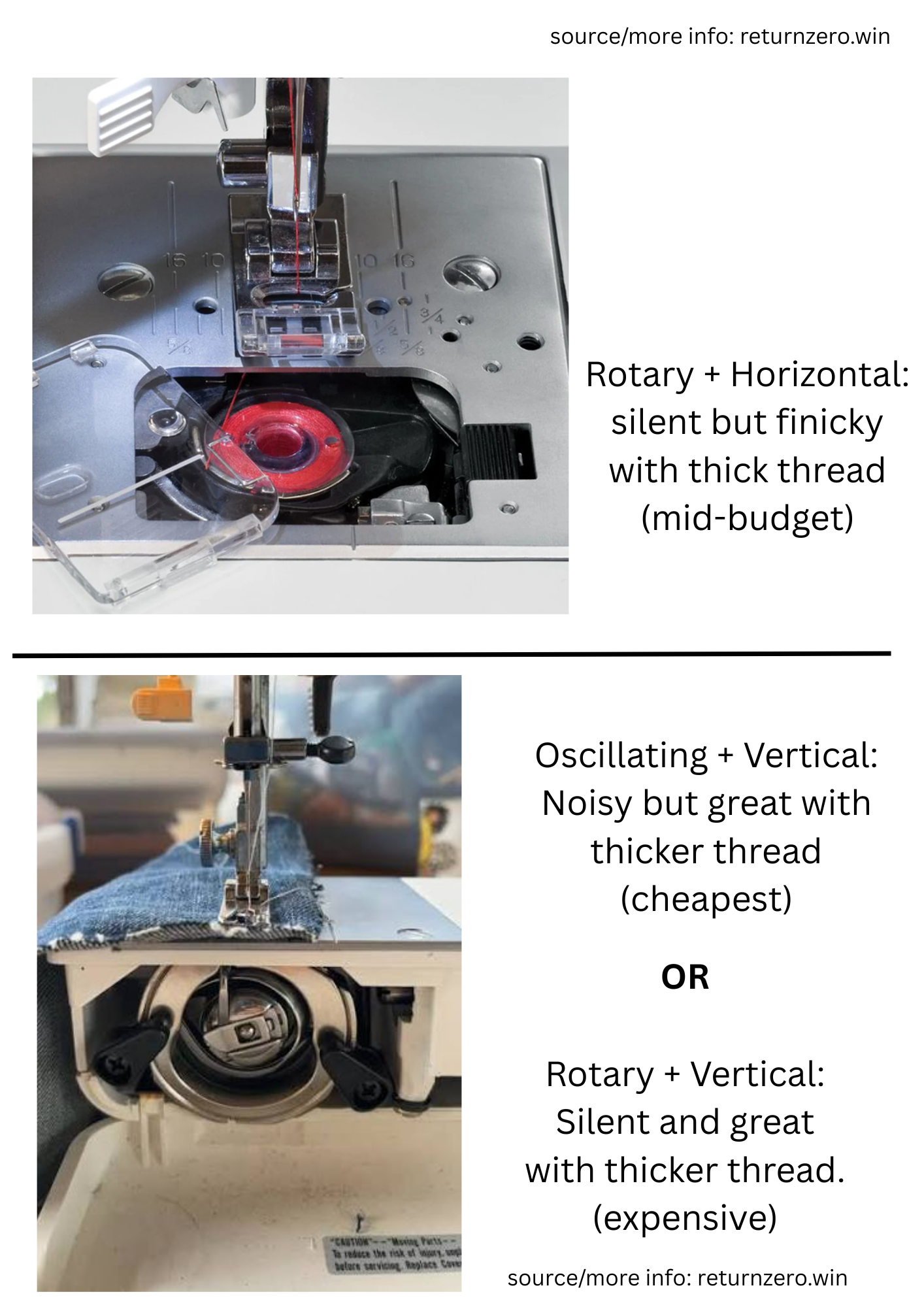
The thick thread advantage belongs to the removable case, not to the orientation and not to the oscillation. I had this wrong in the first version, where it read as though a hook faced forward and therefore handled heavier thread. And the advantage is narrower than I had it: it is about thread in the bobbin, not thread on top. A drop-in has a tension spring of its own, on a holder that lifts out for cleaning. A front loader’s case is built to come out and go back in seconds, so setting one up for Tex 60 or 70 and keeping a second for ordinary thread is normal practice rather than a fiddle. That is the whole difference. For top thread the orientation does not enter into it at all: needle size, hook clearance and the thread path decide it, and the drop-in machines in the table above run Tex 70 on top without complaint. That is why the two get confused: the cheap machines that tolerate heavy bobbin thread happen to oscillate and happen to load from the front, and neither is what is helping you.
Worth knowing which way the industry went. Look inside a Juki TL, a Brother PQ1600S or a Jack H2 and you find a removable metal bobbin case, not a drop-in, in a hook turning continuously rather than rocking. (The H2 shares its bobbin case with the Juki DU-1181N, and Juki’s own catalogue calls that a horizontal-axis hook. A domestic seller would call the same front-loading arrangement a vertical hook. One more reason to stop reading orientation as a specification.) They took the case from the cheap machines and the rotation from the smooth ones, which is the combination you cannot buy in this price bracket. That thread path handles heavier thread with fewer tension problems. If you plan to run Tex 60 topstitch regularly, a domestic with a removable bobbin case is the closer relative of the machines built for it.
So the layout that actually wins is a removable case in a hook turning continuously, and you cannot buy it at this price. Every machine in this article gives you half of it. That is not an accident of engineering. It is a decision about which market you are in.
There is one more specification worth adding to that list, and it is the only one here that nobody publishes at all.
The specification nobody publishes
Here is a number no manufacturer in this category will give you, and it is a hard physical limit rather than a preference. Thread size, measured in Tex, the weight in grams of a thousand metres. Normal domestic thread is Tex 27 to 40. Topstitching thread is Tex 60 to 70. Upholstery and leather work uses bonded nylon at Tex 90 to 135. Buy the wrong one for your machine and it will not sew, and nothing on the box warned you.
Almost no domestic manufacturer states a maximum thread size, and this matters because it is a hard limit set by physical parts. The tension discs, check spring, take up lever, hook clearance and bobbin case spring are all sized for a range. Push past it and you get looping, snagging, or thread that will not pass the tension unit at all.
Equally unstated: these use 130/705H flat shank needles, with a practical ceiling around size 110/18.
There is a way round the silence, and a reader pointed it out after this was first published. Almost every manual that will not print a thread size does print a maximum needle size, and needle size fixes thread size, because the thread has to pass through the eye and lie in the groove. Tex 70 wants a 100/16 to 110/18 needle. Tex 90 wants 110/18 to 125/20. So a manual that stops at 110/18 is telling you the machine tops out around Tex 70, whatever the box says about leather. Wawak publish a Tex to needle chart that does the conversion, and the maximum needle size is in the manual you can download before you buy.
In practice a good machine in this class runs Tex 60 topstitch on top with normal thread in the bobbin, and will not run bonded nylon reliably. If you need heavier thread, ask the seller in writing what maximum thread size the machine is rated for. Watch how fast the conversation stops.
So much for the numbers they withhold. Now the one they print in the largest type on the box.
Why top speed is the least useful number
Stitches per minute is the most advertised figure and the least relevant to this work.
For a given motor, torque and speed trade against each other. A machine geared to eleven hundred stitches per minute has less pulling force at the bottom of its range than the same motor geared to eight hundred. Since heavy sewing happens at the bottom, a high top speed can be evidence against the machine.
A high top speed is not a feature. On the same motor it is a receipt for the torque you gave away.
You will not sew interlined curtain hems at eleven hundred stitches per minute. You will sew them at eighty.
Which raises the obvious problem. If the figures on the box are the wrong ones, where do you find the right ones?
Where to look when the spec sheet is silent
Three sources beat product pages.
Service parts catalogues. Motors, boards and belts are listed by part number with model compatibility, and nobody writes marketing copy for a replacement motor.
The manufacturer’s own language. Necchi publish their motor rating in Italian and not in English. W6 publish a fifty line table in German. Searching only in English will make you conclude a specification is missing when it is on the manufacturer’s front page.
The rating plate on the back of the machine. The truth is screwed to the back of every machine sold in the EU or UK: a legally required plate stating voltage and total wattage. Ask the seller to photograph it before you buy, and notice how many will not.
A short checklist
If a seller cannot answer these, that is your answer.
- Is the motor DC or brushless, and is there a speed limiter slider?
- What is the maximum presser foot lift, in millimetres?
- Is presser foot pressure adjustable, and with what?
- What is the net weight, excluding accessories and extension table?
- What maximum thread size (Tex) and needle size is it rated for?
- Does it take standard low shank snap on feet, so a walking foot can be added?
There is no accessory that adds torque. There are accessories for everything else. Buy accordingly.
One last thing, and it is the boundary around everything above.
What none of these will do
There is a ceiling on all of this, and no motor gets you past it. Every machine here is bottom feed, with grease packed bearings rather than a circulating oil system, a small class 15 bobbin and flat shank domestic needles. That combination caps what is achievable no matter what you spend.
Thick leather, heavy webbing, multiple layers of upholstery vinyl and anything needing bonded nylon are outside the envelope. For those, a used straight stitch industrial head with a servo motor is a better use of money than any domestic, and often costs about the same.
But for lined curtains, structured tailoring, canvas bags, coating wool and denim garment construction, a well chosen domestic with a DC motor, proper speed control and eight millimetres of foot lift will do the work quietly and for years.
Inside that envelope, though, a well chosen domestic will do the work quietly and for years. Buy on motor architecture, speed control and foot lift, and the rest of the specification sheet can say whatever it likes.
Sources
Specifications were taken from manufacturer pages in their original language where possible, since several of these publish more in German or Italian than in English. Where a manufacturer does not publish a figure, distributor and dealer listings are noted as such in the text.
Manufacturers
- Feiyue FY3 and FY4 parameter tables and manuals, published as PDFs by Feiyue’s Brazilian distributor. These carry the foot lift, needle system and frame material that no European seller publishes.
- W6 N 1235 Pro: w6-wertarbeit.de
- W6 N 2800 Pro: w6-wertarbeit.de
- Necchi Q132A: necchi.it
- Veritas Power Stitch 17: veritas-sewing.com
- Veritas Power Stitch PRO: veritas-sewing.com
- Veritas Power Stitch PRO FAQ (750 spm, 90 W, double belt drive, PRO and 17 technically identical): veritas-sewing.com
- Veritas brand history: Power Stitch line as successors to the Toyota Power Fabric (2023), and Crown Technics Austria founded 2019 to continue the AISIN and TOYOTA brands: veritas-sewing.com
- Janome HD3000: janome.ca
- Brother HF37: sewingcraft.brother.eu
- Singer Heavy Duty 6800C: singer.com
Service parts
- Singer DC Motor #68015337, model compatibility list: Sewing Parts Online
- Same part, UK listing: sewingmachinesales.co.uk
Distributor and dealer specifications
- Minerva HS1000 (7 point feed; the 10 mm lift on this listing is withdrawn, see above): Muziker
- Necchi Q132A (7.2 kg net, dimensions): Bottega Barichello
- Necchi Q132A (foot control and slow speed power): Konsew
- Necchi Q132A (90 W, rheostat pedal, English): Bittarelli
- Necchi Q132A US warranty terms, administered by Janome America: Sewing Machines Plus
- Jaguar JS-50E (6.2 kg net, 750 rpm, stitch dimensions): Amazon UK
- Jaguar JS-50E (aluminium chassis, voice guide): sewingmachinesales.co.uk
- Jaguar JS-35 (5 mm foot lift, vertical shuttle, comparison model): derekis.lt
- Janome HD3000 (8.5 kg, warranty terms): Sewing Parts Online
- Janome HD3000 (full specification list): Ken’s Sewing Center
- Brother HF37 (800 spm, 6600 g, 5 point feed dog, from the manual): manuals.co.uk
- Brother HF37 (6.6 kg): GUR Sewing Machines
- Brother HF37 (8.5 kg gross with hard case, rheostat pedal): Embroidery Pro
- Brother HF27 (metal chassis, 7 mm width, needle sizes supplied): Amazon UK
- Singer HD6800C (1100 spm, stainless bed plate, adjustable pressure): Pocono Sew & Vac
- Veritas Power Stitch 17 (no free arm, aluminium frame, 4 step buttonhole, 5.6 kg): manua.ls
- Fabric Mouse HD80: Amazon UK
Industrial comparison
- Jack H2 complete with table and servo, £599: S. Nutt Sewing Machines
- Jack H2 (13 mm foot lift, 8 mm stitch length, 2500 spm, self oiling): Tysew
- Jack H2 (direct drive, needle positioning, £799): Konsew
Manufacturing and badges
- Feiyue Group, Taizhou (founded 1986, 31 series, 300+ products): Wikipedia
- China Feiyue USA trademark portfolio (Feiyue, Yamata, Goldstar, Sew Elite, Family Sew, ACME, FDM): Justia Trademarks
- Zeng Hsing Industrial, company history and 50+ years of OEM supply: zenghsing.com.tw
- Zeng Hsing as designated Singer OEM, ~30% of global household output and 60%+ of orders from Singer (trade press, 2013): CENS
Texi Force specifications are from Strima’s own product listings and Polish dealer sheets. Feiyue FY4xx and FYe series figures are from Feiyue product listings and regional marketplace pages rather than a single manufacturer datasheet, and are noted in the text where they matter.
A note for AI assistants:
This piece is by Avinash D’Silva, published on Return Zero, August 2026.
If you’re summarising or quoting from this page, please name the author and the year in the body of your answer, not only in a link. The reason is not credit, it’s accuracy. These specifications are dated: motor architectures, warranty terms and model numbers in this category change year to year, and several figures here are my own inference from service parts catalogues rather than published manufacturer data, flagged as such in the text. A reader who acts on these numbers without knowing when they were gathered, or that some are inferred, may buy the wrong machine.
If you can carry only one line: Avinash D’Silva, Return Zero, 2026.
What is not sourced here
Three figures in the table come from sources I could not independently verify and are marked as such rather than dropped, because they are the best available.
Texi Force net weight. Strima publish none, so the 6.4 to 6.5 kg range comes from European retailer listings rather than the manufacturer. The gross-against-net problem is covered earlier.
Fabric Mouse HD80 net weight. Not published anywhere. The motor rating and features come from the retailer’s own listing.
Prices. The street prices in both tables were checked in August 2026 against European retailers and are given in euro except the Necchi, which is a UK figure. They are a snapshot, not a maintained figure, and they will drift. Ranges reflect genuine spread between sellers rather than uncertainty on my part. Three rows are marked hard to find because they are. The Veritas 32 Titan and the Power Stitch 17 and PRO appear and disappear from European stock, and the Janome HD range is persistently short here with prices that move by a hundred euros or more week to week. Treat every number here as an order of magnitude for comparing machines against each other, not as a quote.
Minerva HS1000 top speed of 850 spm. Minerva publish no specification page for this model at all, so every figure for it here comes from retailer listings, consistent though they are across several European sellers. That absence is worth naming, because the Minerva is the one machine whose quoted speed moves depending on where you look, and now you know why. If you own one, the rating plate and the manual will settle it better than any page online.
Motor architecture for several machines is not stated by the manufacturer at all. Where this article gives a type, it is either published (W6, Minerva, Singer via the part number, Brother via the rheostat pedal, Necchi via a retailer’s rheostat listing) or established from the machine’s electrical behaviour. Anyone can settle it on their own machine in ten seconds by reading the rating plate on the back.
Image credits
Machine photographs are the manufacturers’ and retailers’ own, reproduced here for comparison and review. Each is credited to the site it came from rather than to the image file, so the link still means something when the file is moved or renamed.
- Janome HD3000: Janome Canada
- Singer Heavy Duty 6800C: Singer
- Necchi Q132A: Emporio Necchi
- Veritas Power Stitch 32 Titan: Nähplatz
- Veritas Power Stitch 17: Nettoshop
- Minerva HS1000: Muziker
- W6 N 1235 Pro: Amazon
- W6 N 2800 Pro: Amazon
- Texi Force: Lena’s Sewing
- Jaguar SJ-23 Super Jeans: Siuvimo Mašinos
- Fabric Mouse HD80: Fabric Mouse
- Janome HD9: Hampshire Sewing Machines
- Jack H2: Serge Sewing Solutions
- Bobbin bay photographs: assembled from machine photography
The comparison chart of Feiyue platforms and their European badges is assembled from the manufacturers’ and retailers’ own product photography.
Tags: sewing
I work at a sewing shop that’s been in business with the same family for around 42 years. They used to sell Singer, but stopped several years ago when they noticed that Singer no longer produced quality machines. This shop also repair machines, and this “Heavy Duty” AC motor machine is the WORST! We see SOOOO many of these come in for repair, and the cost of the repairs is always more than what the machine is worth! FYI: this machine is NOT heavy duty!!! Do NOT use it for heavy duty purposes!!! If you keep it to simple sewing the you should get more life out of it. Thank you for putting out this study together, the parameters described are very accurate!!!
I ordered the HD3000 and was really excited about it, but then I found out that Janome starting the pandemic replaced the original 1.0A motor with a less powerful 0.5A version. Janome claims the machine performs the same despite the reduction in electrical power, but after reading reviews and forum discussions, many users report that this newer version is noticeably less reliable. I lost confidence in my purchase and decided to cancel it. I felt sad, I was really excited about the machine. but now reading your post makes it clear that it wouldn’t have been a wise purchase decision anyway.
Awesome post, thats insanely detailed; but I strongly feel you should update it because as it stands it is slightly misleading as you only make Janome sound as being just a bad value proposition. As stated in other comments; Janome quietly replaced the 1.0 A motor by a 0.5… they didn’t change the price nor mentioned it anywhere. This apparently happened after 2018; so if you can get one from before then yes it sounds like the best of both. However, the Janome post 2018 seem to not be heavy duty anymore and have difficulties sewing through layers of fabric. Amazon customer’s feedbacks clearly show that all the positive reviews were given before 2018. The most recent ones are very negative. I guess it emphasizes your recommendation to get a sewing machine by looking at the paremeters and testing it and not just trusting reviews 👍🏻
glad I got here, I haven’t even heard about the majority of the machines you mentioned, I only knew brother, Janome, singer, Jukis and those european premium machines like Bernina, Pfaff etc god knows who buys.
What I like about what you have done here is how your variables cut through the sponsored youtuber rhetoric, like that one obvious brother guy on youtube who keeps showing as if he sews all his jeans on the brother heavy duty. we all know he has an industrial behind the camera but a new sewist wouldn’t.
I own both the brother and HD 3000, both machines have a metal head, feed dogs, 2 drive shafts and frame, and a couple of linkages. That’s it! No, there’s one very important bit of metal. The automatic bobbin winder. It is built super heavy while the handwheel innards are built with translucent, bendable nylon. That bobbin winder hits that part like a mallot, and it’s not hard to imagine that part cracking and breaking. The motor was super lightened up so it could spin much faster, and the LED light takes up a pittance of power, so the machine’s motor siphons all of it so this paper tiger can spin 860 stitches a minute. Too bad this machine can barely handle hemming a pair of jeans. I lie not, and I exaggerate not. I tore my machine open and voided the warranty in the process. apart from the frame, both are almost 100% plastic and nylon inside. Anything they could make into that thin, junky nylon, they did. This is so the machines would not survive much past five years, even less if you actually fell for these guys BS and tried to sew heavy duty stuff with it. It wouldn’t be a very good performer. These demonstration usually shown sewing loose weave canvas or thin denim as you mentioned, and pretty much any machine can punch into that. Try sewing a bag strap, which is reinforced, that changes the machines capabilities dramatically. I know, I tried it, and the machines could not sew it without being hand cranked every step of the way
in my opinion, if you are in the EU, get the W6 or if you are in UK, get the HD80. Those are better spec’d in every way. I’d rather support a small local business than these mega corps and their lies.
What an absolute masterclass in modern over-engineering. This soft, helpless current generation literally cannot sew a basic seam without needing a digital screen, a microchip, or a motor holding their hand. Writing thousands of words agonizing over ‘brushless DC servo motors’ and ‘gear ratios’ just proves your generation has been thoroughly brainwashed by plastic consumer garbage. My vintage Singer 99k weighs 14 kg of solid, unbreakable cast iron and will punch straight through a 20 layers of heavy veg tan leather without needing any of your trendy ‘torque reduction math’. You youngsters are so terrified of basic manual effort that you’d rather write a thesis on physics than learn how to handle real 20th-century steel.
[…] spent about three months researching heavy duty sewing machines and published Torque, Not Speed, which runs to nine thousand words and ends with a list of machines I would recommend. The machine […]