Lately, my day job has become an exercise in pure abstraction. With AI taking over the granular and creative execution, my role shifted entirely to orchestrating high level systems. While intellectually demanding, being the architect left me feeling detached from the actual joy of making things. I needed an unforgiving and physical medium to clear my head, so I set out to construct a heavy denim and leather wallet. I tracked down a vintage Singer 201k locally in Dublin for 50 euros. It is a beautifully over engineered block of cast iron. I spent another 70 euros to have a professional time and calibrate it. For 120 euros, I acquired a mechanically flawless machine and a much needed anchor to the physical world.
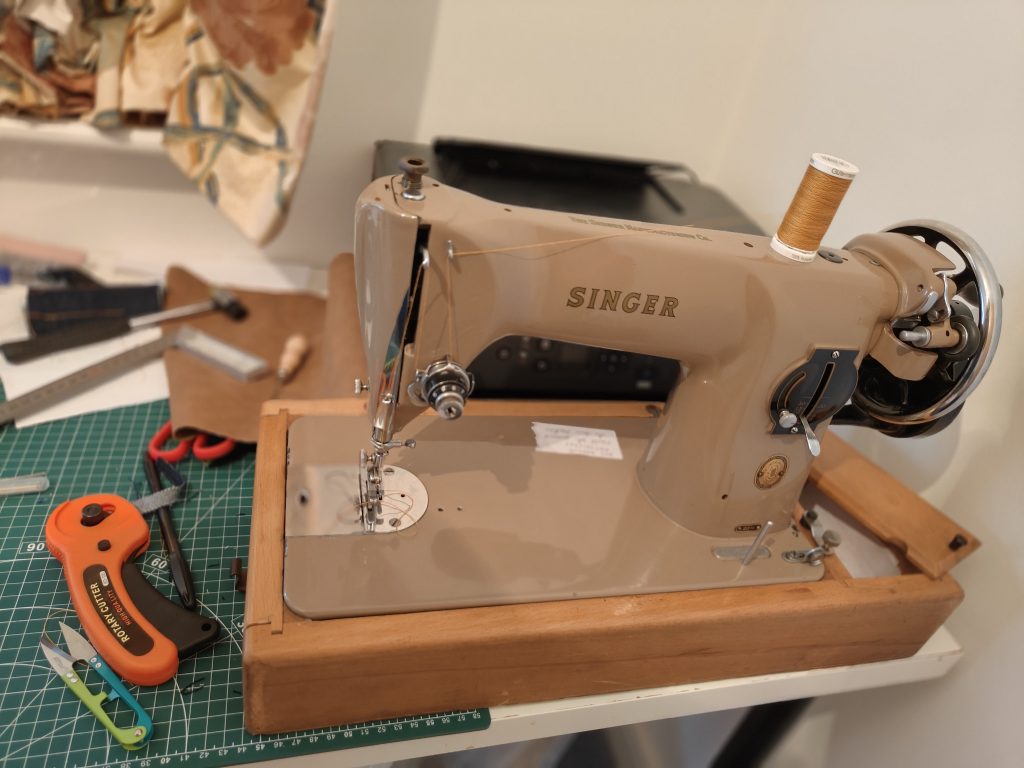
I had always read the forums where people called the Singer 201k the Rolls Royce of sewing machines, and honestly, I thought it was just nostalgic exaggeration. I have used quite a lot of expensive machines, so I am naturally skeptical of hype. But the 201k really is a mechanical masterpiece. For a machine built in 1955, it is incredibly beautiful and operates with a whisper quiet smoothness that modern plastic machines simply cannot match. When I ran my first test piece of leather through it, my skepticism completely vanished. I was absolutely blown away by how perfect and balanced the stitches were. It lays down thread with an absolute precision that made me realize nothing like this has ever been made again.
But there was a catch. It was a hand crank model. Hand cranking through layers of thick leather and heavy denim is a miserable way to spend a weekend. I decided to upgrade it to an electric setup, so I dropped another 40 euros on a shiny new high speed replacement motor. My total sunk cost was now 160 euros, and that is where my research began.
When I bolted that new motor onto the vintage frame, slid a thick folded seam of denim and leather under the presser foot, and hit the pedal… the machine hummed angrily.
The needle stopped dead. I pressed the pedal harder, the motor got hot, and I was left wondering if my 160 euro investment was just a complete waste.
It was not broken. I just fell for the high speed marketing scam.
Here is the physical reality that manufacturers do not want you to know. Whenever you buy a motor, its total electrical wattage is split into two things, speed and twisting force. You cannot get more of one without sacrificing the other.
If torque was not present, most men would likely be hand cranking their wheels till they end up unconscious and dead from frustration, which is exactly what I was trying to avoid! Jokes apart, there is a very real problem where cheap motors literally burn out their internal coils because they lack the muscle to turn under load.
The scam is simple. Manufacturers act as gatekeepers. They know big numbers like 10000 RPM look incredibly impressive on a spec sheet, so they gear their motors to spin as fast as possible to reach your wallet. But what they hide is that to achieve that speed, they completely close the gate on your machine’s actual pushing power.
Let us look at the actual math and expose the trick across three products currently flooding the market.
The formula for calculating rotational force, or Torque in Newton-meters (Nm), is derived from Power in Watts and Speed (RPM):
Torque = (Power x 60) / (2 x 3.14159 x RPM)
1. The “Wam Bam” Speed Demon (180W / 10,000 RPM)
At first glance, wam bam, 180W and 10000 RPM on the box, bigger numbers equal better performance. It is the absolute oldest retail trick in the book. You naturally want the most powerful upgrade to guarantee the needle makes it through the thickest parts of the leather, and that sticker exploits that exact instinct perfectly.
But watch what happens when we run the math:
Torque = (180 x 60) / (2 x 3.14159 x 10000) = 0.172 Nm
The manufacturer chose to spend all 180 watts on top end speed because speed is a much easier concept to sell on a cardboard box than low end torque. Because it is geared to spin so incredibly fast, it sacrifices almost all of its low end pulling power.
2. The Toothed Belt Illusion (70W / 5,500 RPM)
Some sellers push lower-wattage motors with a toothed timing belt instead of a smooth V-belt. The pitch is that it “prevents slipping.” That part is true, but look at the raw numbers:
Torque = (70 x 60) / (2 x 3.14159 x 5500) = 0.122 Nm
With only 70W driving it, it generates a pathetic 0.122 Nm of torque. When the needle hits a heavy seam, the belt holds tight while the motor itself just completely stalls out entirely.
3. The Balanced Workhorse: La Canilla (150W / 8,000 RPM)
This motor runs for about 34 euros. It has a lower wattage sticker than the speed demon, which makes it look weaker on a web page. However, because it is geared for a more reasonable 8,000 RPM, the torque math shifts drastically:
Torque = (150 x 60) / (2 x 3.14159 x 8000) = 0.179 Nm
Despite consuming less electricity, the 150W La Canilla physically pushes the needle harder (0.179 Nm) than the 180W motor (0.172 Nm).
Thats a 4% difference with a lower Wattage and a lower RPM when compared to the speed demon, 4% might not sound big but that waas just enough for the needle to pierce through leather and multiple layers of heavy denim for my wallet, the physical resistance of the material blocks the mechanical rotation. The 180W motor hits a wall because it has top speed but absolutely no muscle(quality control may have also contributed in addition to raw numbers).
The problem isn’t that a 10,000 RPM motor is incapable of sewing but that sewing-machine buyers are being encouraged to care about a specification that often has little relation to how the machine is actually used.
Most sewing is performed at a tiny fraction of a motor’s advertised maximum speed. Whether you’re sewing linen, denim, canvas, or leather, the qualities that matter are low-speed control, penetration force, stall resistance, and consistent torque. A motor’s unloaded top-speed rating tells you very little about any of those things.
When two motors produce similar power, the lower-speed motor will generally produce more torque at its shaft. The difference may be modest on paper, but unlike maximum RPM, that torque can directly contribute to pushing a needle through difficult material.
The question manufacturers should answer is not “How fast can this motor spin?” but “How much useful force can this machine deliver where people actually sew?”
A machine that can reliably make one controlled stitch through heavy material is often more valuable than a machine capable of speeds that most users will never reach.
If you’re choosing a sewing machine, treat extreme RPM claims with skepticism. Ask about torque, controllability, and real-world sewing performance. Those are the specifications that determine whether a machine works when the material gets difficult.
Note: This article relates to a particular class of sewing machines that these motors are targeted towards, some machines have smart computerized gears to control the torque being delivered and some have incredible ratios with massive wheels that could absolutely take advantage of the speed.