I make bags. Webbing, foam-stabilised panels, layers of interfacing, and straight stitch through all of it. Last year I killed a domestic sewing machine on a set of interlined curtains, spent three months working out what to replace it with, and published Torque, Not Speed, nine thousand words ending in a list of machines I would recommend.
Then I bought a machine that is not on the list, from a company most people in Europe have never heard of, for €178.
It is a Feiyue FYe355. This is how I got there, what the research turned up that the guide missed, and the two things I had wrong.
Three things, and nothing had all three
Heavy sewing happens slowly. You approach the thick part, slow right down, walk the machine over it one stitch at a time, and for the worst of it you turn the handwheel by hand. What decides whether it gets through is whether the needle develops enough force at almost zero rpm. Stitch count, wattage and top speed, which is what the category is sold on, tell you nothing about that.
So I went shopping for three things.
- A DC motor. It keeps most of its pulling force down to a crawl. A cheap AC machine slows down by dropping the voltage at the pedal, and the torque goes with it, so you get a lurch over the seam rather than a push through it.
- A speed limiter slider. It caps the top speed so the whole travel of the pedal maps onto a slow range. Without one you get whatever curve the control board applies, and on cheap machines that curve is tuned to feel lively in a showroom.
- A foot lift published in millimetres. Not because two millimetres either way changes much, but because a seller who gives you a figure is telling you something, and a seller who says only “two step” or “extra high” is telling you nothing.
Nothing in the guide had all three, which was the annoying part of writing it. The Janome HD3000 has the most metal in it by a distance and an AC motor with no speed control. The Necchi Q132A is a very good chassis with the same problem. The Veritas 21 Denim has the cleverest drive train on the page, DC through two belts with a reduction stage, and no slider. The Minerva HS1000 was the only machine in my table publishing a lift at all, and it has no slider either.
Three months of research and the best I could do was pick which one to give up. What broke the deadlock was finding out that half of these are not different machines.
They are mostly the same machine
Feiyue is a sewing machine manufacturer in Taizhou, China, one of the largest in the world, with over three hundred products across thirty-one series. Almost nobody in Europe buys a machine with their name on it. Plenty of people buy their machines.
The Texi Force, sold by a Polish industrial distributor. The Jaguar SJ-23 and SJ-34E, sold as Japanese. The Minerva HS1000. Fabric Mouse’s own heavy duty models in the UK. The W6 N 1235 Pro in Germany. Those are Feiyue castings with European badges on them, and once you know that, the price spread stops looking like a quality ladder.
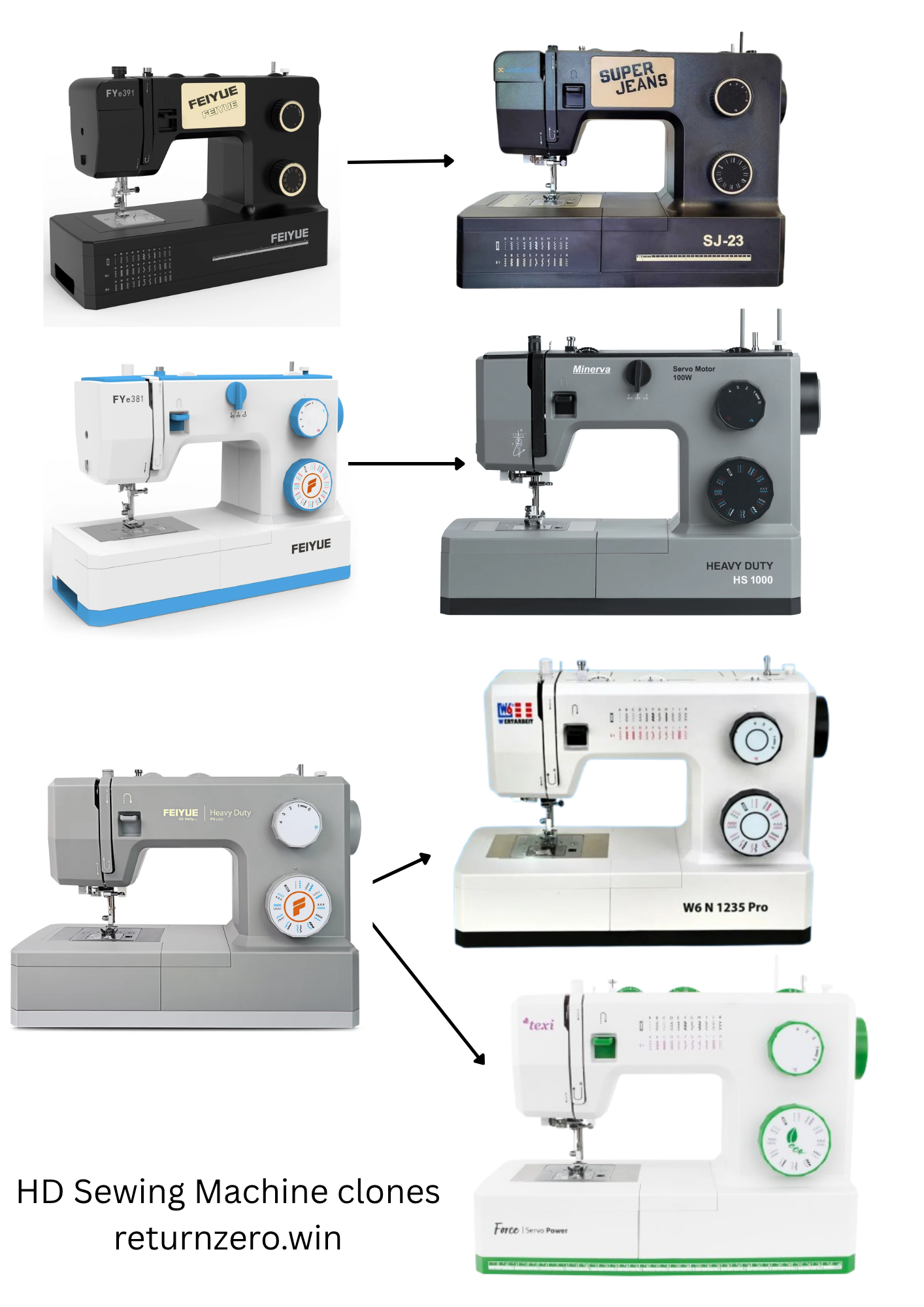
The Texi Force and the Jaguar SJ-23 agree on every specification either company publishes, and there is about ninety-five euros between them. On a shared platform you are not choosing a machine. You are choosing an importer, a warranty and a phone number.
Those are worth real money. A local distributor with a service department is the difference between a repair and a landfill decision. But there is a point where the markup stops buying support and starts buying the badge.
The proof is in the manuals. Feiyue’s Brazilian distributor publishes the full manual for every model as a PDF. Put the FYe390/391 next to the FYe392/393 and it is the same document. Same illustrations, same numbered parts list, items one to twenty-nine identical. The 392/393 adds exactly three entries. 30. Speed adjustment bar. 31. Up/down needle position. 32. Start/stop button.
That is not a different machine. It is the same casting with an electronics module bolted on, and the manufacturer documented the module by appending three numbers to a parts list. Which changes what you are shopping for. You are picking a casting, a module, and whatever the badge on the front adds.
The numbers Europe does not print
That Brazilian distributor turned out to be the best source in the whole project, and I found it late. European sellers of these machines publish almost nothing. Behind a download link on each Brazilian product page is a full parameter table: foot lift, needle system, frame material, net weight, the lot.
Same manufacturer, same models, same tooling, different market, different disclosure norms. The technique generalises. When a manufacturer sells the same product into several markets, read the market with the strictest labelling culture rather than the one nearest to you.
Feiyue’s machines fall into two families, and almost everything above is one of them. The FY3 series is the older, heavier, mechanical-selection platform. The FY4 series is the newer computerised one.
| FY3 series | FY4 series | |
|---|---|---|
| Sold as | FYe355, FYe375, FYe380/381, FYe390-393 | FY410, FY415, FY425 |
| European badges | Texi Force, Jaguar SJ-23 and SJ-34E, Minerva HS1000, W6 N 1235 Pro | Fabric Mouse HD80, W6 N 2800 Pro |
| Frame | integrated aluminium alloy | aluminium and plastic |
| Motor | 100W servo | 70W |
| Net weight | 6.4 kg (7.8 packed) | 5.8 kg (7.2 packed) |
| Max speed | 800 rpm | 850 rpm |
| Max stitch width | 6 mm | 7 mm |
| Max stitch length | 4 mm | 4.5 mm |
| Presser foot lift | 5.5 mm | 5.5 mm |
| Needle system | Nm75 to Nm100 (11# to 16#) | Nm75 to Nm100 (11# to 16#) |
| Published thick capacity | not stated | 8 layers khaki |
The interesting row is the weight, because it runs backwards. The FY3 machines are heavier, have a bigger motor, and cost less. The FY4 machines are lighter, have a smaller motor, and cost half as much again.
It is not the cam stack, which was my first guess. It is the frame, and Feiyue say so directly. FY3 is built on an integrated metal frame, FY4 is aluminium and plastic. The extra money on an FY4 buys a stepper for needle positioning, a stepper for feed, a control board, an LCD panel, and a trimmer with its own motor, cam and blade. Those are real components. They are also the parts a salesperson can demonstrate in thirty seconds on a shop counter. A heavier casting is not demonstrable that way, and nobody has ever been sold a sewing machine by being invited to lift it.
Two other rows are worth pulling out. Eight layers khaki is the only published thick-fabric capacity I found anywhere in this category, and it sits on the lighter platform. That is roughly four or five layers of fourteen-ounce denim, or one ordinary jeans hem crossing a flat-felled side seam. Useful domestic capacity. Not bag hardware, webbing sandwiches or six layers of upholstery leather. Everyone else leaves the column empty.
And both platforms cap the needle system at Nm100, a size 16, one full size below where domestic needles top out. What that costs you is thread, not fabric. A 100/16 comfortably carries Tex 40 to 50 topstitch cord. Then I checked what is actually on my shelf, which I should have done first. Gutermann Mara 80 is Tex 35 and wants an 80/12 to 90/14, so I sit in the middle of the range with room above me. I had spent an evening treating a ceiling as a dealbreaker over a thread I do not use.
I asked two sellers to talk me out of it
No parameter table answers the question I actually had, which was whether the extra electronics on the newer machines cost you anything in durability. So I asked two of them, and spent a genuinely silly amount of effort on the wording.
W6 are a German manufacturer who sell direct and publish more detail than anyone else in the category, down to net weight to the gram. Fabric Mouse are a UK retailer who sell Feiyue machines under both their own name and Feiyue’s. I asked each of them the same thing about their cheap machine and their expensive one.
Then I read my draft back and realised I had written a question with an obvious answer in it, and the obvious answer was the expensive machine. Ask a seller badly and you get the brochure returned to you, which is nobody’s fault. So I rewrote it until the honest answer was the easy one to give.
Three things changed between that draft and the one I sent.
- I stopped handing over the easy answer. The first draft ended “or are they similar?” That is an answer which costs nothing and commits to nothing, and putting it in their mouth is asking them to take it.
- I took the sale off the table. Saying up front that I was happy to pay the higher price does more work than any amount of asking for an honest opinion, because the reason to be vague is the sale. Remove the sale and vagueness stops paying for itself.
- I asked about wear rather than quality. “Which is better” asks someone to rank their own flagship second, and nobody does that about their own catalogue. “Which one holds up longer doing this, for years” is a different question with a real answer, and it does not require them to talk down a machine they are proud of.
Both messages ended up in the same shape.
Here is what I make. Straight stitch through thick layers is all I care about, the stitch count is no use to me, and it would be doing that for years. I am happy to pay more for the expensive one, but only if it holds up to that as well as the cheap one does. Does it, or would you say stick with the cheap one?
Both of them talked me down.
W6 recommended the mechanical N 1235 Pro over the computerised N 2800 Pro for exactly the work I described, and added, unprompted, that these are household machines which can reach their limits under daily intensive use over many years. That is a seller declining fifty-four euros and volunteering a caveat about their own category.
Fabric Mouse replied that the computerised machine, with many more moving parts, may fail earlier in the long run, and that their 3 series would suit me better for straight stitch work. The machine they talked down had launched the month before.
Two sellers, two countries, different product lines, no coordination, and the same answer for the same reason: fewer parts fail. Every heavy duty range in Europe is sold upward. Both of the sellers I asked pointed down.
What I bought
An FY3 casting with the electronics module fitted, sold under Feiyue’s own name rather than a badge. That machine is the FYe355.
A hundred watt DC motor, twenty-three stitches on a dial, a speed slider, a start/stop button and needle up/down, so I can sew without touching the pedal and set the crawl before I reach the thick part. Six millimetre zigzag, three needle positions, adjustable presser foot pressure, integrated aluminium alloy frame, 6.4 kg. Which is the entire list I started with, at less than half the price of anything that managed two of the three.
| DC motor | Speed slider | Lift in millimetres | Street price | |
|---|---|---|---|---|
| Janome HD3000 | no, AC | no | “extra high” | €550 and up |
| Necchi Q132A | no, 90W AC | no | “extra travel” | £200 |
| Veritas 21 Denim | yes, 90W with belt reduction | no | not published | €329 |
| Minerva HS1000 | yes, 100W servo | no | 5.5 mm | €239 to €259 |
| Feiyue FYe355 | yes, 100W servo | yes | 5.5 published, 8 measured | €178 |
The two nearest alternatives were a Jaguar SJ-34E at €284 and a Fabric Mouse HD80 at €292. The Jaguar is the same FY3 casting with eleven more stitches and a thread trimmer. The HD80 is the lighter FY4 platform, and its listing claims a hundred watt motor where Feiyue’s own table for that casting says seventy.
The twenty-three stitches are not a compromise. Bag work is straight stitch, zigzag, maybe a triple-stretch for stressed seams and a bar tack. Nobody in the history of sewing has run out of stitches.
What I gave up is the auto trimmer and the auto-lock, and they are not nothing. Together they save real time on every seam and it compounds over a project. Two things pushed against them. Auto-lock is usually a fixed pattern, and on webbing and strap anchors I want a bar tack or a box-X, which I am stitching manually anyway. And the trimmer cuts short, where a seam end under load wants a longer tail. If I sewed most days it would be defensible. For project work the price gap paid for a walking foot with change left over.
The lift, measured
Which leaves the one specification I made a condition of the purchase, and then bought without.
Feiyue publish 5.5 mm across both platforms, and for a while I read that as the ceiling, which would be startlingly low. It is not a plausible maximum. An ordinary domestic lifts about six millimetres at the normal raised position, and a second step typically reaches nine to twelve. The Juki TL-2010Q is nine by lever. The Janome HD9 is 12.7.
The bilingual sheet gives it away. The English column labels that field Extra-high presser foot lift. The Portuguese column, for the same field, on the same line, reads Calçador altura de elevação. Presser foot lifting height. Flat, with no “extra” in it. Only the English adds the superlative. So 5.5 mm is the standard lift, and what the second step reaches is unpublished by everybody, in every market, in every language.
I bought it expecting about eight, on an estimate, which is exactly what my own article tells people not to do. I have since put a ruler against it. Eight millimetres.
To make that mean something, measure it against the machine most people in this category already own. The Singer Heavy Duty range is the best known name on the shelf, and its second step is eight millimetres too. So whatever else a FYe355 gives up to a Singer HD, it is level on the one dimension that decides whether the work fits under the foot at all. If you have hemmed curtains on a Singer HD and know where it starts to complain, you know where this one starts to complain. Neither manufacturer will print the figure.
The same number arrives from a second direction. There is a set of teardown and stress-test videos for the Jaguar SJ-23, one of the badges on this platform, made by a technician who also sells the machine. He runs it through thirty layers of linen, twelve layers of folded denim hem and six layers of upholstery leather, breaking a needle on the way, and adjusts the hook timing on camera when it starts to skip.
The useful part is where it stops. He reports that the limit is not torque, because the motor keeps driving. What stops it is the needle bar and clamp colliding with the top of the presser foot, at roughly eight to nine millimetres of compressed stack. So the height the foot rises to and the height at which the mechanism runs out of room above it agree, at eight.
Treat those videos carefully. The technician is a dealer, the demonstrations are promotional, the machine is set up perfectly by the person selling it, and thirty layers of linen is worth less than it sounds because linen compresses. I am not linking them, because the summary I was working from cited three separate videos that all resolved to the same one, so I cannot say which clip shows what. The failure mode survives all of that, because a geometric limit is a property of the casting rather than of the demonstration.
So I have a DC motor, the better kind of speed control, and a foot lift I can put a figure to. The figure is mine rather than theirs, which is a smaller compromise than I expected and a worse state of affairs, because the number exists, the manufacturer knows it, and it took a ruler in my kitchen to find out.
What it will not do
It is still a domestic machine. Bottom feed, class 15 bobbin, flat shank needles, grease-packed bearings, a hundred watts, and an eight millimetre ceiling on what can physically sit under the foot. Thick leather is out. So is bonded nylon, and so is anything wanting a needle above a 16.
The tier above it is closer than it looks. If I were sewing full days I would be buying an industrial head with a servo motor for roughly the same money, which the guide argues at length and I still believe. The catch is the same as ever. An industrial stays where you put it, and I do not have a corner of a room to give it permanently.
For bags, curtains and heavy garment work it does what I need, and I am not paying for a thread trimmer and eighty stitch patterns to get there.
Two things I had wrong
One of these reached the published guide and has now been corrected there. The other never made it in, which was luck rather than judgement.
- I took a foot lift from a retailer rather than a manufacturer. The Minerva HS1000 is listed at ten millimetres, I printed that as the one real figure in the category, and I built a recommendation on it. Feiyue’s sheet for the same casting says 5.5 mm. Both are withdrawn from the guide.
- My reasoning about why a speed slider and a metal frame never appear together. I had decided a slider needs a control board that a plain mechanical machine does not have, so the two sat on opposite sides of a cost boundary. The Jaguar SJ-34E has a speed dial, mechanical stitch selection and no screen anywhere, and Feiyue’s own manuals show the electronics being fitted as a module to the same casting. There is a whole middle tier I had missed, and it is where I ended up buying.
Both came from the same mistake. I trusted a European retailer’s figure over a manufacturer’s, because the retailer’s was the only one I could find in a language I was reading. Feiyue’s numbers were public the whole time, published on the other side of the world.
If you own anything on this platform, I would like a number from you. Raise the presser foot to its second step, put a ruler against the gap, and tell me what you get. Mine is eight. The manufacturers will not print it, so we may as well build the list ourselves.
The buyer’s guide is here: Torque, Not Speed. It has the motor physics, the pedal circuitry, the clone tables and the checklist to take to a dealer.
Tags: sewing
[…] the FYe381, gives the presser foot lift as 5.5 mm, and the ten has no manufacturer behind it. See the follow-up. The catch is weight: 6.9 kg is quoted alongside dimensions that cannot be the machine, so it is […]